


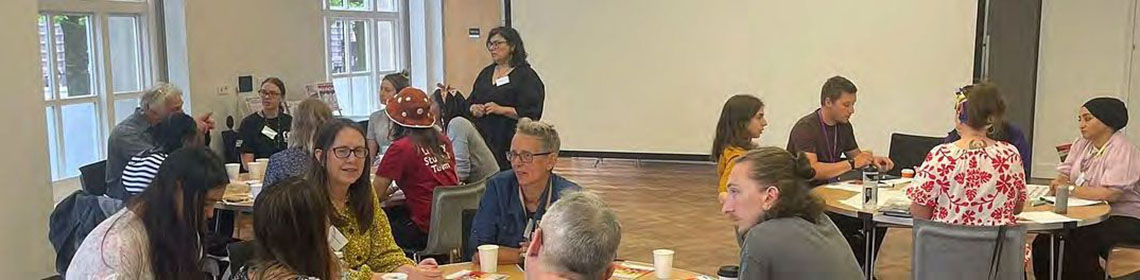
Theme 2: Shaping services through listening
Students and researchers are not users of the Library; they are the reason the Library exists.
Everything we do must be designed with and for them, shaped by their voices, responsive to their needs.
Transforming the Student Experience
The student voice tells us clearly: our spaces are our greatest weakness. We hear this in NSS responses, in daily conversations, in how students use our buildings. The Main Library alone welcomes almost 12,000 student visits every day and Manchester 2035 will, through Manchester Online, mean the University Library will be delivering services to 100,000 students by 2035. We must listen and act.
Library Teaching and Learning
Library teaching is foundational to student success and to research excellence, and as the University grows toward 100,000 students, the scale, quality and reach of that teaching matters more than ever. We will articulate, expand and resource the full breadth of Library teaching: information and digital literacy embedded across taught programmes; credit-bearing modules where the Library leads or contributes; peer-led skills development and the partnership role we play in course and programme design.
We will explore and expand our Special Collections teaching programme, recognising that direct engagement with rare books, manuscripts and archives is one of the most powerful pedagogic experiences a research-intensive university can offer. The Library will continue to be a partner in course design across the Faculties and the central source of skills support for the entire University, including through the My Learning Essentials (MLE) platform. By 2030, Library teaching will be visible, valued, measured and growing in scope and credit-weight, sitting alongside our research support as equally constitutive of who we are.
6. Main Library Transformation Project
- Manchester 2035 Leap: Flexible Learning
A complete reimagining of the Main Library is critical to deliver Manchester 2035's hybrid learning vision. If half our students will study online or through workplace routes, the Main Library must transform from poorly-maintained study hall into a world-class flexible learning ecosystem. This means adaptive spaces that reconfigure for different uses, technology-rich collaboration zones, asynchronous support infrastructure, and seamless digital-physical integration. This directly addresses our NSS performance on study spaces and responds to Manchester 2035's challenge about 'modern, purposeful accommodation designed for belonging, wellbeing and community.' By 2030, our NSS scores will rank in the top quartile.
7. Students as Learners: Skills, Collections and Peer-Led Learning
- Manchester 2035 Leap: Flexible Learning
If we're serious about driving social mobility and serving students who engage with us at 10pm from workplace settings, we need dedicated infrastructure: asynchronous support available 24/7, digital and information literacy curriculum embedded in every undergraduate programme, peer-led learning that recognises students as teachers as well as learners, and proactive outreach to at-risk students. This includes measuring outcomes; do students who use these services have better retention, degree outcomes, employment? This is equity as strategic investment, not charitable gesture. We will eliminate every barrier we've unconsciously built. We will move past assumptions about prior knowledge, hidden costs, cultural capital required to navigate our systems. Students from all backgrounds will see the Library as theirs.
Research Support for Impact
Research excellence that doesn't translate to impact is a luxury we cannot afford. We commit to positioning the Library as active participant in Manchester's innovation ecosystem.
8. Research Data Infrastructure 2.0
- Manchester 2035 Leap: Research Impact
Research Data Management has been reactive, helping researchers comply with funder mandates. RDI 2.0 is proactive: becoming essential infrastructure for Manchester's four strategic platforms (Creative, Digital, Environment, Health). This means specialised data services for each platform, partnerships with industry on proprietary data access, leadership in regional data initiatives, and positioning the Library where research data goes to be preserved, shared, and reused. It means the University Library must be unexpected in where it works, on innovation campuses as well as student campuses. Our special collections become research datasets. Our data services provide essential infrastructure. Our expertise in information management drives environmental research. Our historic medical collections inform health futures. Our management of data is as rich as that of research articles and other outputs. We embed from inception in research platforms, not as an afterthought.
Open Access Leadership and Truth-Telling
We commit to remaining a national leader in Open Access, which means taking positions that create productive conflict with commercial publishers. The Manchester Open Research Environment will be internationally recognised for seamless integration into research workflows, innovation in publishing models, leadership in transformative agreements, and data publishing standards.
Our commitment to openness extends decisively to teaching content. Open Educational Resources (OER) will be a central plank of how the Library supports Manchester 2035, opening teaching materials at scale, working with academic colleagues to flip closed content to open, and contributing to a global movement that puts Manchester at the forefront of open pedagogy. With 100,000 students by 2035, the impact of OER on access, attainment and equity will be substantial; the impact on the institution and on research-led teaching, transformative; and our influence on national and international sector practice, significant.
But our commitment to truth goes beyond Open Access. In an age of misinformation, we teach critical evaluation of sources, detection of manipulation, navigation of complex information landscapes. Through our journalism collections, our open education initiatives, and our public programming, we model truth-seeking rather than bias-confirmation.
9. Manchester Open Research Environment: Sector Leadership
- Manchester 2035 Leap: Research Impact
The Manchester Open Research Environment (MORE) will become internationally recognised as a model for institutional repository infrastructure, shifts away from subscriptions and Open Access leadership. We will achieve 100% Open Access compliance for eligible publications by 2029. We will innovate in publishing models, exploring diamond Open Access and initiatives that challenge commercial monopolies. We will lead in transformative agreement negotiations, taking principled positions that may create productive conflict with publishers but that serve the long-term interests of scholarship. We will develop data publishing standards that position Manchester at the forefront of open science. MORE will integrate seamlessly into research workflows so that sharing becomes the path of least resistance. Our Open Access leadership will be measured not just by compliance rates but by our influence on sector practice and our contribution to a more equitable scholarly communication system. We will also lead the move to open materials for teaching and learning, including through Flip to Open initiatives that systematically transition closed teaching content to open access at scale.
Collections as infrastructure
10. Flip to Open
- Manchester 2035 Leap: Flexible Learning
We will lead the move to open materials for teaching and learning, including through Flip to Open initiatives that systematically transition closed teaching content to open access at scale. Flip to Open reflects the Library's commitment to pedagogical innovation, digital transformation and sector leadership, while addressing systemic challenges such as escalating publisher pricing, restrictive licensing models, and financial pressures. Through this work, the Library aims to remain at the forefront of open education, driving local impact and contributing to global change.
11. Strategic Storage Review and Next Generation Access
- Manchester 2035 Leap: Innovation Powerhouse
Not just moving books to cheaper space but reimagining our entire collections footprint for 2035, integrated across the University's cultural institutions. What stays on-site? What goes to high-density storage? What gets digitised-then-deaccessioned? What do we acquire differently? This includes piloting innovative retrieval systems (robotic delivery, scan-on-demand rather than physical delivery) and rethinking our relationship with print in an age where discovery is often digital-first. This responds to the Manchester 2035 challenge 'walking away from legacy systems that no longer serve our mission' while ensuring world-class collections remain accessible and sustainable.
12. Knowing Our Users: The Library's Digital Estate
- Manchester 2035 Leap: Digital University
We will develop a comprehensive, evidence-based understanding of how user behaviours and expectations are evolving in an AI-enabled environment. Users are shifting away from traditional service channels toward alternative platforms, expecting more flexible, personalised, and accessible options. The emergence of AI and large language models offers new ways for users to access content and interact with services, increasing demand for tailored experiences. We will build dashboards to track and predict student engagement across web and social media channels. We will conduct focus groups with students and external partners to understand changing expectations. We will investigate how large language models access and present library data and assess our control over content presentation in third-party discovery platforms. We will establish a repeatable data collection process for early trend detection, enabling rapid adaptation to shifting user needs. By 2027, the University Library will have sector-leading intelligence on user behaviour, enabling us to anticipate rather than react to changes in how students and researchers discover and engage with our services and collections. We will review our digital collection platforms through the Re:Collect Project and, driven by evidenced user requirements, ensure digital collection access is fit for purpose and robust for future research, teaching and civic engagement initiatives.