



The Flexible Learning Programme's legacy - and the next chapter for teaching and learning
14 Jan 2026
The Flexible Learning Programme leaves a strong legacy of digital innovation, flexible teaching spaces, and lifelong learning opportunities, paving the way for 'Flexible, personalised and digitally enabled learning' by 2035.
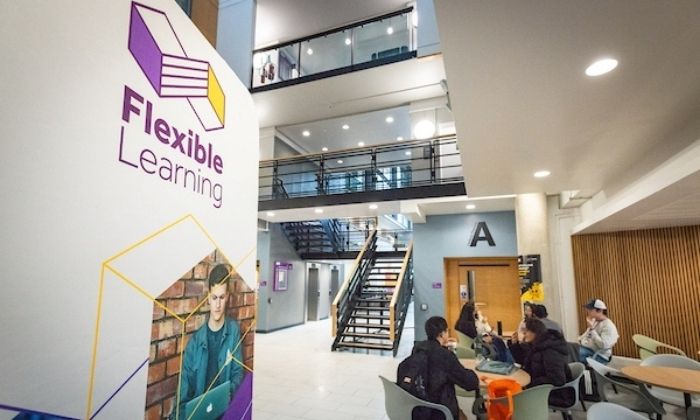
As the Flexible Learning Programme (FLP) came to a close at the end of 2025, we would like to thank all staff and students across the University for your tremendous hard work and efforts to help shape and deliver changes we set out to deliver since 2021.
Professor Dan George, Programme Director, Flexible Learning Programme said: “ I want to express my heartfelt thanks to everyone who contributed to our success. Together, you have helped transform the way we teach and learn, embracing innovation and collaboration at every step.
"The legacy of FLP will continue to shape our University’s approach to flexible, personalised and digitally enabled learning. I am immensely proud of what we have achieved and excited for the future as the University builds on these foundations.”
Why we started
With a fragmented approach to online and blended learning, and an increasing market demand for lifelong learning opportunities, it became clear more coordination was needed across the University to make lifelong flexible learning possible.
In 2022, we launched the Flexible Learning Strategy setting a clear vision and strategic goal to create lifelong flexible learning that is inclusive, accessible and international.
Benefits we’ve delivered together
As a result of collaborating closely with staff, students, alumni and external partners, we’ve delivered a range of benefits to enhance and improve the teaching, learning and student experience such as:
Improvements to our Digital Learning Environment
We managed a major and successful transition from Blackboard to Canvas, as part of our Digital Learning Environment, through University-wide collaboration and strong governance to improve the Teaching, Learning and Student Experience.
Teaching spaces that support flexible learning
After launching our Teaching Innovation Space at Booth Street East, we subsequently piloted and evaluated these Spaces, including the Hyflex teaching space for ‘dual delivery’ teaching, a set of VR pods for safe use of headsets and a tech‑free room for discussion-based teaching.
Testing new ideas for teaching and learning
Our Flexible Learning pilots provided an opportunity for staff and students to put into practice the principles of flexible learning, by testing new ideas, establishing new practices and processes and enhancing how we deliver teaching and learning.
Becoming a learning partner for life
To increase access to a Manchester Education, we’ve collaborated with external industry partners, including Hyperion Dev and the Bank of England, to deliver courses flexibly, and worked with colleagues to develop a costing model and approvals process for our lifelong and professional learning programmes. As part of this work, Manchester is recognised as a UNESCO City of Lifelong Learning.
Building digital capability and equity
We launched a range of digital tools to help improve and develop our staff and students’ digital capabilities and skills, including the Jisc Discovery tool and LinkedIn Learning, while also working with the Students’ Union to launch the Digital Equity Charter for students.
Empowering the student voice
From the beginning, we have placed students at the heart of our programme, empowering their voice to influence, and shape change that affects their teaching and learning.
Promoting cross-faculty collaboration in our digital learning service
We delivered a co-created service for eLearning that offers agility, flexibility and ability to scale enabling cross-faculty working and sharing best practice.
Establishing national sector principles for flexible assessment
Through the QAA Collaborative Enhancement Project on Optionality in Assessment, this work has now been adopted by over 20 institutions across the UK and underpins the new national framework for flexible assessment.
What happens next
Continuing to implement and make improvements to Canvas
Support will continue for students and colleagues using Canvas across the University through our first formal assessment period. We will also guide colleagues though the start of Semester 2, where more courses will go live, some teaching with Canvas for the first time.
Embedding Canvas for the future
The team is working to ensure Canvas continues to improve and supports our colleagues within Teaching, Learning and Student Experience. Conversations are ongoing with senior leaders and key stakeholders to ensure any new structures and processes proposed align with the Manchester 2035 Strategy, supporting the leap allowing for flexible and digitally enabled learning.
Manchester 2035
By 2035, the University will be looking at delivering a new kind of student experience as part of one of our key five leaps, ‘Flexible, personalised and digitally enabled learning’. We will continue to work with employers and industry partners to co-create new professional learning programmes together that address their skills needs for the future. The experiences, insights and activities that took place in FLP have laid the foundations to enable this leap to come to life over the next decade.
This leap will help us deliver teaching more flexibly beyond the physical limits of campus to help learners access a Manchester education online whether locally, nationally and globally.