


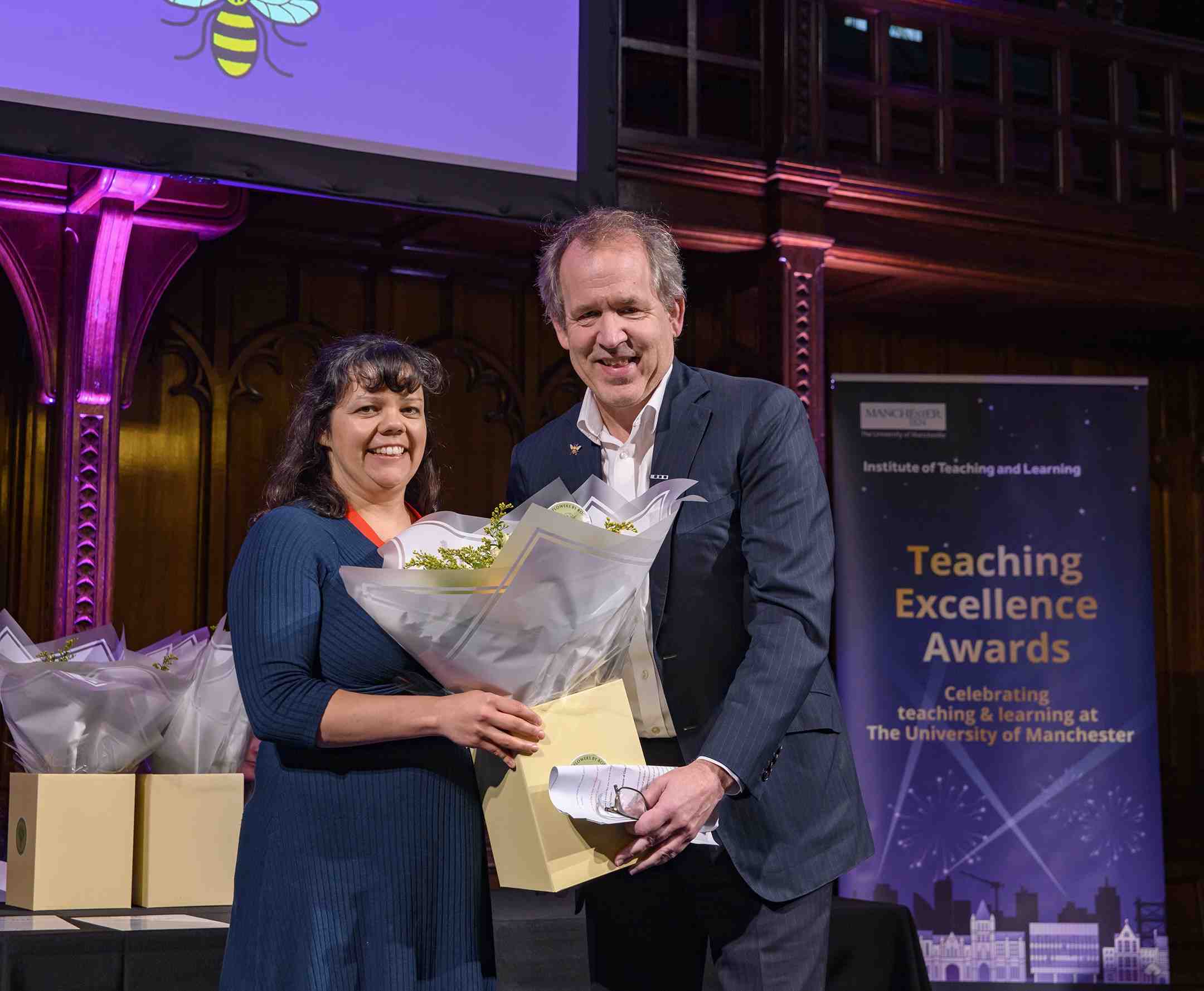
Teaching Excellence Awards
Teaching Excellence Awards are made in recognition of significant and sustained commitment to excellence in the delivery and/or support of teaching and learning at UG or PGT level. Academic, Lab-based, Technical, Library and other Professional Service colleagues are eligible for the award. Reflecting the evolution of our practice and ways of working, our Teaching Excellence Awards celebrate the strength and diversity of practice in our University of Manchester community.
The Teaching Excellence Awards look for:
- a commitment to excellence in teaching and/or support for learning over a sustained period, and intellectual engagement with teaching and supporting learning. This should involve evidence of an evidence-informed approach, coherence, and evaluation.
- strategic alignment and clear articulation of the ‘need’. (Value)
- evidence of positive change (Impact) and its Reach, including engagement beyond the nominee's immediate academic or professional role.
Strategic themes
Submissions should demonstrate how the nominee’s activities contribute to one or two of the following strategic themes:
- Educational Leadership
- Inclusive Education
- Flexible Learning and Digital Delivery
- Assessment and Feedback
- Student Voice
Award winners are
Celebrated:
- Gifted a commemorative trophy
- Invited to a formal awards ceremony
Invited to play a role in teaching and learning development at University level:
- Given the permanent title of Honorary Fellow of the Institute of Teaching and Learning and access to the Fellows Network
- Encouraged to act as ambassadors for teaching and learning within the University and beyond
Offered personal development opportunities:
- (Optional) access to the national Advance HE Teaching Excellence Awards pipeline (National Teaching Fellow / Collaborative Award for Teaching Excellence) run by the Teaching Excellence team
- Opportunity to contribute guest post(s) on the University's Teaching Excellence blog, TEA: Teach, Explore, Apply
Number of awards
Number of Awards
The awards will be made on a competitive basis as follows (regardless of strategic theme):
|
Individual |
Team |
||
|
Top 3: |
Award |
Top 2: |
Award |
|
Next 3: |
Highly Commended |
Next 2: |
Highly Commended |
|
Next 3: |
Commended |
Next 2: |
Commended |
|
Total Individual: 9 |
Total Team: 6 |
||
* the panel has discretion to go up to five in any category for exceptional cohorts of nominations.
Who is eligible?
Nominations are invited from:
- academic, lab-based, technical, library and other Professional Services staff
- individuals or teams (up to 15 members per team)*
Individuals and teams may:
- self-nominate (in which case you will need ONE senior colleague to contribute a supporting statement to your submission form)
or
- be nominated by a colleague. If you wish to nominate someone else for a Teaching Excellence Award you will need at least TWO other colleagues to add their support to the case that you make on the nominee's behalf.
The panel will take into account that a nominee’s scope for reach, value and impact will look different at different stages of a person’s career and in different disciplines or roles. The quality, extent and relevance of evidence should be commensurate with the individual's context and opportunities, and we look forward to receiving nominations from across the University.
*if your team has more than 15 core members please contact the Teaching Excellence Team at teaching.learning@manchester.ac.uk
How do I submit a nomination?
Formats
All nominations must be submitted on the Teaching Excellence Case for Award proforma (as a word.docx), and uploaded via the online submission portal (see Submitting your nomination below). The case for award will be accepted in the following formats*:
- 1000-word written submission (Section 2 of the proforma)
- a 5 minute pre-recorded presentation e.g. narrated slides, a video or other approach (please add a hyperlink to your presentation within Section 2 of the proforma, as well as uploading a copy of the slides/a transcript, as appropriate)
Colleagues are encouraged to make submissions using the format which best allows them to highlight the reach, value and impact of the nominee’s work. Submissions must be backed up by evidence, both qualitative and quantitative, of the claims made within the narrative. In the case of self-nominations, the Supporting Statement is also a significant piece of evidence of the claims made in the submission.
*alternative formats may be agreed – please contact the Teaching Excellence team at teaching.learning@manchester.ac.uk in advance of submission if you would like to discuss this.
Statement on the use of Generative AI
Whilst Generative AI tools, such as those related to spelling and grammar, might be appropriately used to support the nominee in developing a Claim, the content must be the nominee’s personal and authentic work.
Senior Supporting Statement
In the case of self-nominations, the Supporting Statement is a significant piece of the submission. The supporting statement should be provided by a senior colleague (e.g. Head of Department/Division) who is in a position to:
- corroborate the evidence of reach, value and impact made within the nomination
- help the panel to understand and evaluate the reach, value and impact of the candidate or team’s achievements within their local working context
- (optional) provide additional evidence of Reach, Value and Impact, or frame the context of the practice in such a way that enhances the evidence for the Claim for excellence.
The Panel may request additional information from the applicant, author of the nominee’s Supporting Statement, and or/Head of School or similar to corroborate statements made in the claim e.g. as to impact and the nominee’s context.
Submitting your nomination
Nominations should be presented on the Teaching Excellence Case for Award proforma, including all necessary signatures and/or statement of support as required, and uploaded via the online submission portal.
Deadline for nominations: 19:00 BST on Monday 08 June 2026
If you have any questions please contact the Teaching Excellence team at teaching.learning@manchester.ac.uk
The core criteria
The core criteria against which applications will be evaluated are:
|
Sustained excellence
|
The underpinning principles of the Teaching Excellence Awards include a commitment to teaching and supporting learning. Evidence of outstanding contribution to teaching and learning should therefore extend over at least the preceding 2-3 years. |
|
Strategic alignment
|
Nominations should be framed within the University’s context and priorities for teaching, learning and the student experience as set out in Manchester 2035 and the Mcr 2035 Delivery Handbook. Alignment with other plans may also be relevant, e.g. the Access and Participation Plan, Teaching Excellence Framework (TEF) etc. |
|
An evidence-informed approach
|
Nominations should demonstrate intellectual engagement with teaching and learning. This should involve evidence of the use scholarship, or research, or professional learning, or other evidence-informed approaches as a basis for effective practice. Nominations do not require a record of teaching publication, but where this exists it can be taken into account along with impact on teaching, learning and the student experience more broadly. |
|
Evidence of effectiveness Evidence backing up the case for Reach, Value and Impact — commensurate with the individual's context and opportunities — should be cited throughout. The quality, extent and relevance of evidence is a critical factor in enabling the panel to evaluate the nomination, as outlined below: |
|
|
Reach
|
The scale or target of influence. For example, this would normally be expected to include evidence of reach beyond your immediate context – across departmental, faculty, institutional or national levels. Reach also includes
|
|
Value
|
The benefit derived for students and/or staff. Why was the intervention required and how did you know? Evidence of Value is likely to include qualitative evidence, for example feedback or survey data on how the work described has positively changed the student learning experience or colleagues’ teaching practice. Value may also relate to the quality of enhanced experiences and/or the meaningfulness of practices. Some nominees may also be working in settings where there are explicit positive ethical elements to their practice. Winning other awards, successful bids for financial support, alignment with strategic agenda may also be evidence of value. |
|
Impact
|
Evidence of positive change taking place in policy, practice and/or student outcomes as a result of the activity. This is likely to be quantitative, and best evidenced when change can be demonstrated longitudinally, e.g. a rise in Unit Survey score from 2.9 to 3.7 to 4.6 over time or a positive impact on NSS data; a reduction in awarding gaps between 2022 and 2025; or a new procedure being implemented in 5 programmes across 2 discipline areas over the last 3 years. Some impact evidence may also be qualitative, for example, a statement from a student or colleague indicating how their understanding or behaviour has changed as a result of the nominee’s practice. |
|
Plus (Team Awards only): nominations for a Team Award should consider the following questions and relate them to the core criteria:
|
|
|
The evidence and its impact should be corroborated, and put into context, by the Senior Supporting Colleague's statement/nominating signatories. |
|
Evidence and evaluation
Evidence
The case for award must incorporate evidence to back up the claims made throughout. The evidence should be corroborated, and put into context, by the Senior Supporting Colleague's statement/nominating signatories.
Evidence may include (but is not limited to):
- A positive change in student attainment data
- A positive change in student satisfaction (e.g. measured by Unit Survey data/feedback, NSS data/open comments etc.)
- Positive feedback received through Peer Review of Teaching
- Positive feedback from External Examiners
- User data/feedback
- Testimonials
- Interview/focus group data, or input from Student Partners
- Increased engagement rates
- Specific contributions to enable significant improvements in students' outcomes and / or experience
- Recognising and actively supporting the full diversity of student learning requirements
- Organising and presenting high quality resources in accessible, coherent and imaginative ways which clearly enhance learning
- Awards (e.g. Faculty awards, awards from the Student Union, teaching-related awards from PSRBs)
- Successful funding applications
- Commitment to ongoing professional development with regard to teaching and learning and/or learning support
- Effecting positive change with respect to others' pedagogic practice, and/or a change to relevant policy or procedure
- Drawing upon the outcomes of relevant research, scholarship and professional practice in ways which add value to teaching and students' learning
- Dissemination / contribution to pedagogy: a journal article, conference paper, a webinar or workshop delivered by the nominee
- Dissemination of initiatives to facilitate students' learning (across course units, programmes, disciplines, PSRBs, locally, nationally or internationally)
Evaluation Methods
Guidance on different methods and tools you can use to collect data for your evaluation can be found in the Evaluation Toolkit.
The panel
The panel
The award winners will be decided by a panel of representatives from each Faculty, plus the Head of SAS (or nominee) and co-chaired by Dr James Brooks and Dr Jen McBride, as Academic Theme Leads for Teaching Excellence & Quality.
Teaching Excellence Award Winners 2026
The Teaching Excellence Awards recognize exceptional commitment to teaching and learning at the University of Manchester. Open to academic, technical, library and other professional service colleagues, these awards highlight the strength and diversity of teaching practices across the institution.
Awardees become Honorary Fellows of the Institute of Teaching and Learning, gaining access to the Fellows Network and opportunities to shape the future of education at the University of Manchester. Many also take part in personal development through national awards pipelines and share their teaching excellence via the University’s TEA: Teach, Explore, Apply blog and partnership with Times Higher Education Campus+.
Winners
- Rachel Heyes (Learning Technologist, FBMH eLearning team) for Inclusive Education and Flexible Learning and Delivery
- Caroline Hoyle (School of Social Sciences) for Educational Leadership
- Aurelie le Normand (School of Natural Sciences) for Educational Leadership and Inclusive Education
- Drugs: from Molecules to Man FLP Project Team (Team Leader: Richard Prince) (School of Biological Sciences) for Inclusive Education and Flexible Learning and Delivery
- The Manchester Royal Eye Hospital in the Carys Bannister Building Optometry Clinics team (Team Leaders: Paul Rogers and Ravi Ahluwalia) (School of Health Sciences) for Educational Leadership
Highly commended
- Rachel Ashworth (School of Health Sciences) for Assessment and Feedback
- Pietro Paolo Frigenti (Alliance Manchester Business School) for Inclusive Education and Student Voice
- William Holmes (School of Health Sciences) for Educational Leadership and Assessment and Feedback
- The MIE Undergraduate Education Research Conference team (Team Leader: Sara Jackson) (School of Environment, Education and Development) for Assessment and Feedback and Student Voice (2025)
- The MBChB Becoming a Doctor team (Team Leader: Sarah Sharp) (School of Medical Sciences) for Inclusive Education and Flexible Learning and Digital Delivery
- The FSE Compensation and Condonement Working Group 2024-25 (School of Engineering and School of Natural Sciences) (Team Leader: Peter Martin) for Educational Leadership
Commended
- Jude Moss (School of Health Sciences) for Educational Leadership and Inclusive Education
- Salman Shahid (School of Engineering) for Educational Leadership and Assessment and Feedback
- Hannah Wilkinson (School of Environment, Education and Development) for Assessment and Feedback
- MB ChB Community Team - Group Teaching Team (Team Leader: Sarah Merrifield) for Inclusive Education and Flexible Learning and Digital Delivery
- The Workplace Ethics Healthcare Challenge Group (Team Leader: Alison Fisher) for Educational Leadership and Student Voice
Previous Teaching Excellence Award winners (since 2021)
Assessment and feedback
- Aya Van Renterghem, The University of Manchester Library (Curatorial Services) (2024)
- Fatima Malik, School of Health Sciences (2024)
- Neil Patel, School of Medical Sciences (2023)
- Jenni Rose, Alliance Manchester Business School (2023)
- The FSE Teaching Academy Support Team (2021)
Educational leadership
- Dr Maria Canal (School of Biological Sciences) (2025)
- Dr Alison Harvey (School of Natural Sciences) (2025)
- The FSE Mentoring Excellence Team (Team Leaders: Claudia Henninger, Tom Rodgers and Aurelie Le Normand) (School of Natural Sciences) (2025)
- Enhancing Assessments Review (EAR) Team (Team Leader: Jen McBride) (Faculty of Biology, Medicine and Health) (2025)
- Tom Rodgers, School of Engineering (2024)
- Glaucoma Learning At Manchester (GLAM) (Team Lead: Catherine Porter), School of Health Sciences (2024)
- The Medical and Health Education Programme Team (Team Lead: Dianne Burns and Bip Chaudhury), School of Medical Sciences (2024)
- Jenni Rose, Alliance Manchester Business School (2023)
- Sian Yeowell, Division of Student and Academic Services - Education Development (2023)
- Team lead: Rhona McLeod, Genetic Counselling STP Programme Unit BIOL65460 Teaching Team, School of Biological Sciences (2023)
- Chris Godden, School of Arts, Languages and Cultures (2023)
- Jen O’Brien, School of Environment, Education and Development (2023)
- Claire McGourlay, School of Social Sciences (2023)
- The Genetic Counselling STP Programme Unit BIOL65460 Teaching Team (Team lead: Rhona McLeod) School of Biological Sciences (2023)
- MA Educational Leadership in Practice (ELiP) Core Team (Team Leader: Dr Paul Armstrong (2023)
- The Justice Hub (Team Leader: Prof Claire McGourlay) (2023)
- Iliada Eleftheriou, School of Health Sciences (2022)
- Jane Mooney, School of Medical Sciences (2022)
- Becki Bennett, School of Social Sciences (2022)
- Mark Quinn, School of Engineering (2022)
- Sally Hickson, School of Health Sciences (2022)
- Jackie Carter, School of Social Sciences (2022)
- Ali Owrak, Alliance Manchester Business School (2022)
- Amit Jinabhai, School of Health Sciences (2021)
- The Elizabeth Garrett Anderson MSc in Healthcare Leadership Teaching Team (Team lead: Jillian McCarthy) Alliance Manchester Business School (2021)
Flexible learning and digital delivery
- Tom Rodgers, School of Engineering (2024)
- Jenni Rose, Alliance Manchester Business School (2022)
- Charlene Gallery, School of Natural Sciences (2023)
- Jane Mooney, School of Medical Sciences (2023)
- Jessica Grundy, School of Medical Sciences (2022)
- Becki Bennett, School of Social Sciences (2022)
- Mark Quinn, School of Engineering (2022)
- David Butler, School of Arts, Languages and Cultures (2021)
- Jen McBride, School of Biological Sciences (2021)
- Christos Begkos, Alliance Manchester Business School (2021)
- Patricia Perlman-Dee, Alliance Manchester Business School (2021)
- Paul Shore, School of Biological Sciences (2021)
- Marco Gersabeck, School of Natural Sciences (2021)
- Alexandros Kafkas, School of Biological Sciences (2021)
- Hiten Mitha, School of Medical Sciences (2021)
- Richard Prince, School of Medical Sciences (2021)
- Mike Kennard, Executive Education, Alliance Manchester Business School (2022)
- Nick Weise, School of Natural Sciences (2022)
- The Belonging Partnership Project (Reimala Sivalingam and Hamza Badenjiki), Alliance Manchester Business School (2024)
- The Medical and Health Education Programme Team (Team Leader: Dianne Burns and Bip Choudhry) (School of Medical Sciences) (2024)
- Fashion Education and Inclusive Learning Innovators (FEILI) (Team Leader: Lisa Taylor) (School of Natural Sciences) (2024)
- UCIL University College for Interdisciplinary Learning (Team lead: Alison Fisher) (2023)
- Robert Sansom and Giles Johnson, How to Grow a Planet EART11100, School of Natural Sciences (2022)
- The Centre for Academic and Researcher Development (CARD) (Team lead: Rachel Cowen) Faculty of Biology, Medicine and Health (2022)
- The Deaf Education Team (Helen Chilton and Lindsey Jones), School of Health Sciences (2021)
- The Masters in Public Health Team (Team lead: Arparna Verma) School of Health Sciences (2021)
- Practical Laboratory Science BIOL10401 Team (Team lead: Ruth Grady) School of Biological Sciences (2021)
- The Faculty of Science and Engineering Teaching Academy Support Team (2021)
- The Clinical Psychology PSYC31222 Teaching Team (Team lead: Leader: Warren Mansell) School of Health Sciences (2021)
- The Aerospace ‘DroneFromHome’ project (Team lead: Ben Parslew) School of Engineering (2021)
- The Fashion Business and Technology Year Manager Support and Community Team (Team lead: Rachel Parker-Strak) School of Natural Sciences (2021)
- The Elizabeth Garrett Anderson MSc in Healthcare Leadership Teaching Team (Team lead: Jillian McCarthy) Alliance Manchester Business School (2021)
- The Faculty of Science and Engineering GTA LEAP Team (Team leads: Claudia Henninger and Tom Rodgers) (2021)
- The Optometry Programme Team (Team leads: William Holmes and Niall McLoughlin) School of Health Sciences (2021)
Inclusive education
- Fatima Malik (School of Health Sciences) (2024)
- Aya Van Renterghem (The University of Manchester Library (Curatorial Services)) (2024)
- Adam Cooke (The University of Manchester Library) (2024)
- Claire McGourlay, School of Social Sciences (2022)
- Jackie Carter, School of Social Sciences (2022)
- Ali Owrak, Alliance Manchester Business School (2022)
- Mike Kennard, Executive Education, Alliance Manchester Business School (2021)
- Nick Weise, School of Natural Sciences (2021)
- Holly Morse, School of Arts, Languages and Cultures (2021)
- Amit Jinabhai, School of Health Sciences (2021)
- The Student Knowledge Exchange Team (Team Leader: Charlene Gallery) (School of Natural Sciences) (2024)
- Fashion Education and Inclusive Learning Innovators (FEILI) (Team Leader: Lisa Taylor) (School of Natural Sciences) (2024)
- The Faculty of Science and Engineering GTA LEAP Team (Team Leads: Claudia Henninger and Tom Rogers) (2023)
- The Justice Hub (Team Leader: Prof Claire McGourlay) (2023)
- The Undergraduate LEAP Team (Team lead: Nick Weise) (2022)
- The University of Manchester Library Student Team (Team lead: Jennie Blake) (2022)
- Stacey McKnight and Doron Cohen, School of Health Sciences (2022)
- The Optometry Programme Team (Team leads: William Holmes and Niall McLoughlin) School of Health Sciences (2022)
- Centre for Academic and Researcher Development (CARD) (Team lead: Rachel Cowen) Faculty of Biology, Medicine and Health (2021)
- The Deaf Education Team (Helen Chilton and Lindsey Jones) School of Health Sciences (2021)
- The Faculty of Science and Engineering Teaching Academy Support Team (2021)
Student belonging and student voice
- Optometry Year 1 Team (Team Leader: William Holmes) (School of Health Sciences) (2025)
- Adam Cooke (The University of Manchester Library) (2024)
- David Butler, School of Arts, Languages and Cultures (2022)
- Jen McBride, School of Biological Sciences (2022)
- Jen O’Brien, School of Environment, Education and Development (2022)
- Iliada Eleftheriou, School of Health Sciences (2022)
- The Belonging Partnership Project (Team Leader: Reimala Sivalingam and Hamza Badenjiki) (Alliance Manchester Business School) (2024)
- The University Library Special Collections Teaching and Learning Team (Team lead: Janette Martin) (2023)
- The Fashion Business and Technology Year Manager Support and Community Team (Team lead: Rachel Parker-Strak) School of Natural Sciences (2023)
- The Undergraduate LEAP Team (Team Leader: Nick Weise) (2022)
The Covid-19 teaching environment
- The University of Manchester Library Student Team (Team Lead: Jennie Blake) (2021)
- Stacey McKnight and Doron Cohen, School of Health Sciences (2021)
- Practical Laboratory Science BIOL10401 Team (Biological Sciences. Leader: Ruth Grady) (2021)
- University Library Special Collections Teaching & Learning Team (Leader: Janette Martin) (2021)
Highly Commended (since 2021)
Assessment and feedback
- Team Leads: Kun Wang and Ian Stewart, ENGM 60061 Unit Leaders, School of Engineering (2024)
- Michael Smith, School of Biological Sciences (2024)
- Mauro Luberti, School of Engineering (2024)
- Donna Lloyd, School of Health Sciences (2024)
- Mostafa Nabawy, School of Engineering (2023)
- Simon Watson, School of Engineering (2023)
Educational leadership
- Sabia Dayala (School of Medical Sciences) for Educational leadership (2025)
- Emma Ormerod (School of Health Sciences) for Educational leadership (2025)
- Clare Louise Stephenson (School of Health Sciences) for Educational leadership (2025)
- Team Lead: Liz Birchinall, Primary PGCE SLT, School of Environment, Education & Development (2024)
- Team Lead: Janine Dixon, The Materials FBT Academic Team, School of Natural Sciences (2024)
- Team Lead: Jo Conlon, The FBT PGT academic team, School of Natural Sciences (2024)
- Team Leads: Dianne Burns & Catherine Porter, FBMH Pedagogy Development Team, School of Medical Sciences (2024)
- Team Lead: Khristopher Kabbabe, The Aerospace Field Course Team, School of Engineering (2024)
- Emma Pimlott, School of Medical Sciences (2024)
- Janine Dixon, School of Natural Sciences (2024)
- Matthew Alford, Alliance Manchester Business School (2023)
- Scott Midson, School of Arts, Languages and Cultures (2023)
- Jonathan Styles, Alliance Manchester Business School (2023)
- Marianthi Moschou, School of Natural Sciences (2022)
- Tim Price, School of Arts, Languages and Cultures (2022)
- Jonathan Styles, Alliance Manchester Business School (2022)
- Alan Brisdon and Nick Weise, School of Natural Sciences (2021)
- David Mills, School of Natural Sciences (2021)
Flexible learning and digital delivery
- The Postgraduate Academic Enlightenment (PAE) Programme team (Rui He and Stephen Rayner) (School of Environment, Education and Development) for Flexible learning and digital delivery (2025)
- The CHEM10111 Teaching Team (Team Leader: Nick Weise) (School of Natural Sciences) for Inclusive education and Flexible learning and digital delivery (2025)
- CHEM20711 Industrial Biotechnology Team (Team Leader: Nick Weise), School of Natural Sciences (2024)
- Michael Smith, School of Biological Sciences (2024)
- Andrew Hall, School of Health Sciences (2023)
- David Hirst, The University of Manchester Library (2023)
- Mostafa Nabawy, School of Engineering (2023)
- Simon Watson, School of Engineering (2023)
- Team lead: Peter Freeman, The ‘PGCert ClinBio Unit 3, Introduction to Programming’ Team, School of Health Sciences (2023)
- Team lead: Aurelie Le Normand, Fashion, Business and Textiles (FBT) Graduate Showcase Team, School of Natural Sciences (2022)
Inclusive education
- Louise Thompson (School of Social Sciences) For Educational leadership and Inclusive Education (2025)
- The FSE PAL Inclusive Teaching Practice Team (Team Leader: Alison Harvey) (School of Natural Sciences) for Inclusive education and Student voice (2025)
- Team Lead: Louisa Shirley, Team Decolonise, School of Health Sciences (2024)
- Team Lead: Liz Birchinall, Primary PGCE SLT, School of Environment, Education & Development (2024)
- Team Lead: Janine Dixon, The Materials FBT Academic Team, School of Natural Sciences (2024)
- Team Lead: Dianne Burns & Catherine Porter, FBMH Pedagogy Development Team, School of Medical Sciences (2024)
- Team Lead: Nicholas Weise, CHEM20711 Industrial Biotechnology Team, School of Natural Sciences (2024)
- Team Lead: Andrew Mawdsley, The Awarding Dashboard team, School of Health Science (2024)
- Janine Dixon, School of Natural Sciences (2024)
- Matthew Alford, Alliance Manchester Business School (2023)
- Team lead: Peter Freeman, The ‘PGCert ClinBio Unit 3, Introduction to Programming’ Team, School of Health Sciences (2023)
- Katie Twomey, School of Health Sciences (2022)
- Team lead: Victoria Tavares, Pharmacy 'Our Values' Group, School of Health Sciences (2022)
Student belonging and student voice
- Team Lead: Louisa Shirley, Team Decolonise, School of Health Sciences (2024)
- David Hirst, The University of Manchester Library (2023)
- Scott Midson, School of Arts, Languages and Cultures (2023)
- Oliver Hughes, School of Natural Sciences (2022)
- Tim Price, School of Arts, Languages and Cultures (2022)
- Katie Twomey, School of Health Sciences (2022)
- Team lead: Victoria Tavares, Pharmacy 'Our Values' Group, School of Health Sciences (2022)
- Team lead: Aurelie Le Normand, Fashion, Business and Textiles (FBT) Graduate Showcase Team, School of Natural Sciences (2022)
The Covid-19 teaching environment
- Alan Brisdon and Nick Weise, School of Natural Sciences (2021)
- David Mills, School of Natural Sciences (2021)
Commended (since 2021)
Educational leadership
- Team Lead: Dr Sherrie Samuels, The Intermediate Care team, Rochdale Infirmary (2024)
- Lee Wickham, School of Health Sciences (2024)
- Liz Sheader, School of Medical Sciences (2024)
- Emma Jenkinson, School of Biological Sciences (2024)
- Dr Anne M. Hyland, School of Arts, Languages & Cultures (2024)
- Team lead: Prof Li-Chia Chen, International Student Experience Programme Team, School of Health Sciences (2023)
- Carl Gavin, Alliance Manchester Business School (2022)
- Alexander Gardner-McTaggart, School of Environment, Education and Development (2022)
- Lujia Feng, School of Environment, Education and Development (2022)
- Charlene Gallery and Jo Conlon, Digital Futures Industry Summit 2022, School of Natural Sciences (2022)
- Wendy Wild, Alliance Manchester Business School (2021)
Assessment and Feedback
- The Assessment and Feedback Workshop Series Team (Team Lead: Wayne Ramwell), School of Social Sciences (2024)
Flexible learning and digital delivery
- Gareth Henshall (School of Engineering) for Inclusive education and Flexible learning and digital delivery (2025)
- Laura Brown, School of Health Sciences (2022)
- Andras Voros, School of Social Sciences (2022)
- Louise Clare, School of Arts, Languages and Cultures (2022)
- Alexander Gardner-McTaggart, School of Environment, Education and Development (2022)
- Team lead: Polly Turner, MSc Forensic Psychology and Mental Health team, School of Health Sciences (2022)
- Team lead: Mike Kennard, Manchester Leadership Programme Development Team, Alliance Manchester Business School (2022)
- Jenni Rose and Reimala Sivalingam, BSc Accounting Programme Leaders, Alliance Manchester Business School (2022)
- Sarah Shepherd and Jane Mooney, Digital Wellbeing, School of Medical Sciences (2022)
- Charlene Gallery and Jo Conlon, Digital Futures Industry Summit 2022, School of Natural Sciences (2022)
- Team lead: Helen Graham, Skin Ageing and Aesthetic Medicine MSc, PGDip and PG Cert programme team, School of Biological Sciences (2022)
- Marianne Johnson, School of Natural Sciences (2021)
Inclusive education
- Clara Dawson (School of Arts, Languages & Cultures) for Inclusive education (2025)
- Gareth Henshall (School of Engineering) for Inclusive education and Flexible learning and digital delivery (2025)
- Naina Kotecha, Michael Fitzpatrick and Giles Bennett, The PGCE Secondary WAPP team, School of Environment, Education & Development) (2024)
- Francisca Álvarez Figueroa, Alliance Manchester Business School (2023)
- Team lead: Prof Li-Chia Chen, International Student Experience Programme Team, School of Health Sciences (2023)
- Alison Harvey, School of Natural Sciences (2022)
- William Kang, Alliance Manchester Business School (2022)
- Louise Clare, School of Arts, Languages and Cultures (2022)
- Lujia Feng, School of Environment, Education and Development (2022)
- Team lead: Mike Kennard, Manchester Leadership Programme Development Team, Alliance Manchester Business School (2022)
Student belonging and student voice
- Dr Anne M. Hyland, School of Arts, Languages & Cultures (2024)
- Abdullatif Alfutimie, School of Engineering (2024)
- Francisca Álvarez Figueroa, Alliance Manchester Business School (2023)
- Alison Harvey, School of Natural Sciences (2022)
- William Kang, Alliance Manchester Business School (2022)
- Andras Voros, School of Social Sciences (2022)
- Jenni Rose and Reimala Sivalingam, BSc Accounting Programme Leaders, Alliance Manchester Business School (2022)
- Team lead: Helen Graham, Skin Ageing and Aesthetic Medicine MSc, PGDip and PG Cert programme team, School of Biological Sciences (2022)
The Covid-19 teaching environment
- Marianne Johnson, School of Natural Sciences (2021)
Pre-2020 Awards
No nominations were sought in 2020
2019 winners
- Adam Danquah (Clinical Psychology) (2019)
- Jenny Slaughter (Chemistry) (2019)
2018 winners
- Harish Thampy (Medical Sciences) (2018)
- Hannah Cobb (Archaeology) (2018)
- Sam Aston (My Learning Essentials) (2018)
- Stefan Guettel (Mathematics) (2018)
2017 winners
- David Schultz (Earth and Environmental Sciences) (2017)
- Rebecca Farrington (Medical Sciences) (2017)
- Claire Fox (Criminology) (2017)
Contact and Expression of Interest
Please use this form to register your interest in participating in the next cycle of the Teaching Excellence Awards: The Teaching Excellence Awards Expression of Interest Form
For further information or specific enquiries, please contact Emma Sanders.