
Digital Skills
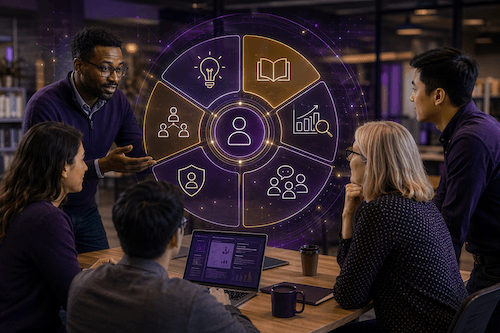
Effective Digital Skills are imperative for all individuals to achieve their goals for the institution and to operate in the digital world.
At The University of Manchester, we utilise the Jisc Digital Capabilities Framework as a sector-standard model for measuring our individual digital capabilities. You can read more information about our approach to the Jisc Digital Capabilities Framework.
Digital Capability, Artificial Intelligence (AI) and Accessibility & Inclusivity are not separate. They are deeply interwoven. We recognise that AI capability doesn't exist without digital capability, and digital capability isn't meaningful if it isn't accessible and inclusive.
Digital Capabilities
Below you can find information relating to the Digital Capabilities, organised by their Jisc Digital Capability category. More information and development opportunities can be accessed for each capability.
Digital Proficiency
Digital proficiency is the ability you have to use digital devices, networks, applications, software and services Proficiency concerns digital mindset more than the mastery of specific tools.
Digital Productivity
Digital productivity is how you use your digital skills to accomplish tasks.
The capability considers the use of digital tools and services to carry out tasks effectively, productively and with attention to quality, and how to adopt and (where necessary) adapt digital tools to personal requirements and ways of working.
Digital Creation
Digital creation is about digital production of content.
The capability considers the capacity to design and/or create new digital content such as writing, imaging, audio and video, digital code, apps or interfaces, and web pages. It is equally applicable to generalist content creation of documents to higher-creative end of audio and video editing or website development.
Digital Research and Problem Solving
Digital problem-solving is your ability to solve problems, make decisions and answer questions.
The capability considers the use digital evidence to solve problems, make decisions and answer questions; collect and collate new evidence including AI generated evidence, evaluate the quality and value of evidence, and to share evidence and findings using digital methods.
Digital Innovation
Digital innovation describes your willingness to try new practices and look for new solutions with digital technology.
The capability considers how we identify, adopt and develop new practices with digital technology in different settings (personal and organisational, social and work-based); assess opportunities, benefits and risks of new digital applications including Generative AI, use digital technologies in developing new ideas, projects and opportunities.
Digital Learning
Digital learning is the ability to turn digital opportunities into personal learning gains.
In many ways this capability depends on our general readiness and motivation to learn, but in some ways digital learning creates demands including participation, reflection and showcasing.
More widely, the capability considers how we participate in (and benefit from) digital learning opportunities; identify and use digital learning resources; participate in learning dialogues via digital media; use learning apps and services (personal or organisational); use digital tools including Generative AI to organise, plan and reflect on learning; record learning events/data and use them for self-analysis, reflection and showcasing of achievement; monitor own progress; participate in digital assessment and receive digital feedback; manage own time and tasks, attention and motivation to learn in digital settings.
Digital Teaching
Digital teaching is the ability to support and develop others in digital settings.
This may mean working in a teaching role, as part of a teaching team or working in a teaching & learning adjacent role. It may also mean supporting development less formally, as an appraiser or mentor.
The capacity considers how we make effective use of digital tools (including Generative AI) and resources to support and develop others in digitally-rich settings; teach; work in a teaching or curriculum team; design learning opportunities; support and facilitate learning; be proactive in peer learning; design and adopt different modes of learning as appropriate (eg self-directed, blended, hybrid, hyflex, asynchronous/synchronous).
Information Literacy
Information literacy is your ability to find, evaluate, organise and share information, whether you are using it for learning, research or professional purposes.
The capability considers how we find, evaluate, manage, curate, organise and share digital information; interpret digital information for academic and professional/vocational purposes, and to review, analyse and re-present digital information in different settings; apply digital information to professional tasks such as problem solving and decision making.
Data Literacy
Data literacy is how you handle data as a special form of information.
The capability considers how to collate, manage, access and use digital data in spreadsheets, dashboards, databases and other formats; analyse data by running queries, data analyses and reports; produce, visualise and interpret data in reports and presentations; work with financial and/or budget data in a personal or professional context (financial literacy).
Media Literacy
Media literacy covers all the ways you receive and respond to messages in digital media.
The capability considers how we critically receive and respond to messages in a range of media formats – text, graphics, video, animation, audio – and to curate, re-edit and repurpose media, giving due recognition to originators.
Digital Communication
Digital communication is any communication using digital media and networks.
The capability considers how we communicate effectively in digital media and spaces such as text-based forums, online video, audio and social media; design digital communications for different purposes and audiences including using AI; respect others in public communications; maintain privacy in private communications; identify and deal with potentially harmful digital communications.
Digital Collaboration
Digital collaboration is the ability to take part in digital teams and working groups to meet specific goals, using shared tools and media.
The capability considers how we participate in digital teams and working groups; collaborate effectively using shared digital tools and media; produce shared materials; use shared productivity tools; work effectively across cultural, physical, social and linguistic boundaries.
Digital Participation
Digital participation means taking part in a more open-ended way than collaboration, over a longer time, and in a range of different settings.
The capability considers how we participate in, facilitate and build digital networks; participate in social and cultural life using digital media, AI and services; create positive connections and build contacts; share and amplify messages across networks; behave safely and ethically in networked environments.
Digital Identity Management
Digital identity management is how you develop and project a digital identity – or several identities – and how you manage your digital reputation.
The capability considers how we develop and project a positive digital identity or identities and to manage digital reputation (personal, professional or organisational) across a range of platforms; build and maintain digital profiles and other identity assets such as records of achievement; review the impact of online activity including AI and Generative AI, collate and curate personal materials across digital networks.
Digital Wellbeing
Digital wellbeing is about the impact of using digital devices, tools, services and systems on you as a person.
The capability considers how we look after personal health, safety, relationships and work-life balance in digital settings; use digital tools in pursuit of personal goals (eg health and fitness) and to support participation in social and community activities; act safely and responsibly in digital environments; negotiate and resolve conflict; manage digital workload, overload and distraction; act with concern for the human and natural environment when using digital tools.
Develop your capability
Below you can find some useful development opportunities so you you can develop your digital capability.

AI Hub
View the AI Hub for latest University AI information
Copilot
Check on the latest updates with Copilot
Digital Inclusion
View the University Digital Inclusion webpages