


ITL Fellowship Projects
We are delighted to announce the appointment of eight new ITL (Institute of Teaching and Learning) Fellows.
Starting in September 2025, ITL Fellows have been appointed to lead projects in key priority areas. The aim of these projects is to deliver a sustainable change across four strategic priority areas within teaching and learning. The priority areas are:
- The Teaching-Research nexus
- Curriculum interventions for student success
- Partner-enabled learning
- Artificial intelligence in teaching and learning
About the projects
Fellows are expected to deliver a change that provides a tangible benefit to our students. To that end, appointed Fellows have been supported in embedding a Theory of Change approach from the outset, ensuring concrete action plans and continued evaluation to support effective implementation with impact. This approach ensures that projects have clear goals, measurable outcomes, and a robust framework for evaluating their impact on student experience and learning.
Projects will run for two years with Fellows working on up to 0.4FTE per-week on a given project. Each project is also supported by a paid Student Partner, helping to ensure the Student Voice is central the project from the outset. Fellows were appointed following a competitive application and interview process.
Meet the ITL Fellows (2025-27)
The Teaching-Research Nexus
Jennifer O’Brien

Jen has been 0.05 on the Fellowship for 2026 ramping into 0.3 next year. Jen is using the University Living Lab (www.universitylivinglab.org) as a lens to better understand where students can learn through research. In that time Aadya, the previous SPI on this project, has presented their work at the ESD Exchange at De Montford University resulting in a publication invitation (on going). Their student led Virtual Conference pilot has been adapted by Social Responsibility and is now a University wide project called 'Coursework for Change' promoted to highlight the role of our student research in our success at the Times Higher Education Sustainability Impact Ratings (formally SDG Rankings). Conversations continue around the role of the University Living Lab in PEL with particular interest from colleagues proposing new large and online units. Summer is a key time for development of the Lab. Two further students will be supporting that work. They have just signed an SLA with Manchester City Council as ULL is listed as an enabler of their Work and Skills Policy.
Professor Jennifer O’Brien NTF, PFHEA is Academic Lead for Sustainability Teaching and Learning at the University of Manchester, the Founder and Director of the University Living Lab, and the Skills (education) Lead for Sustainable Futures. Jen’s Fellowship critically considers how students learn by researching to the benefit of multiple priorities.
A Development Geographer by training, Jen works with Education for Sustainable Development to inspire and equip learners to ethically address challenges of sustainability, inequality and social justice to affect positive change.
Cristina Masters

‘Research-led teaching’ is an often-heard claim at research-intensive universities. It appears in promotion applications, in statements on teaching and in everyday academic conversations, and it is delivered as though what is meant by ‘research-led’ teaching is not only taken as obvious and uncontested, but also as necessarily ‘good’. Cristina's Fellowship project aims to critically probe at what is meant by research-led teaching and challenge its unidirectional orientation where classrooms are perceived as spaces to impart research expertise and knowledge.
There are several potential effects that can be identified from this orientation:
1. recentres the researcher in teaching and learning
2. reproduces the hierarchy between research and teaching already evident in research-intensive environments
3. reproduces the sense that research is something that happens outside the classroom and the classroom as a site where students learn and teachers teach, and not necessarily as spaces where expertise and knowledge is also, and importantly, created for researchers.
Cristina is designing a staff survey on research-led teaching, in consultation with Colette Fagan mapped to the four UoM 2035 platforms, and she aims to circulate it in September. The survey aims to map all taught courses at the University to understand where and what kind of research-led teaching is taking place. Behind the design sits a literature review on the teaching-research nexus, a consultation with the Students' Union, and a review of NSS data from the past two years.
Dr Cristina Masters SFHEA is a Senior Lecturer in International Politics (Department of Politics, School of Social Sciences) and is Programme Director (Politics MA). She is also the School of Social Sciences Lead for the Humanities New Academics Programme (HNAP). Cristina is a Senior Fellow of Advance HE and has a PG Certificate in Higher Education.
David Spendlove
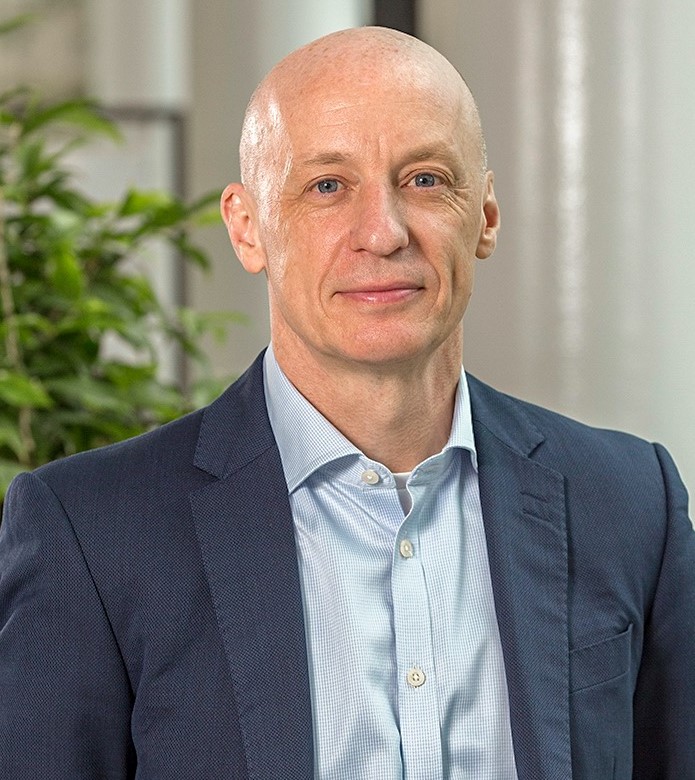
Research-intensive universities frequently claim a strong relationship between research and teaching, but this ‘nexus’, and particularly the translation of research into teaching, is often overstated and under-theorised. While bringing research into teaching can offer significant educational benefits, what ‘Research-Informed Teaching’ actually means, what research should inform teaching, and how this translation can be achieved in meaningful ways remain surprisingly opaque.
David’s Fellowship project explores how academics can be better supported to translate research into teaching while retaining the disciplinary, conceptual and contextual judgement on which good teaching depends. Central to the project is ‘Conceptual Stewardship,’ an innovative framework designed to help academics interrogate the relationship between research, disciplinary content, educational concepts, pedagogy, learning design, assessment and the contexts in which students learn.
The eleven-month project also explores the potential of generative AI as a form of ‘dialogic scaffolding’. Rather than using AI simply to generate teaching materials, academics will be supported to work with AI to question assumptions, explore educational research and concepts, consider alternative pedagogical choices, and make the reasoning behind curriculum and teaching decisions more visible. Human judgement remains central throughout.
Participating academics will apply and test the framework through authentic teaching challenges, including the development or redesign of lectures, seminars and academic units, etc. This will allow the project to examine not simply whether research appears in teaching, but how research is selected, translated and educationally transformed.
Ultimately, the Fellowship aims to develop and test a rigorous, sustainable and considered model for authentically achieving ‘Research-Informed Teaching’, supported by a practical framework and resources that can help academics connect research and teaching.
Professor David Spendlove has held numerous roles, having previously led the University of Manchester Initial Teacher Education provision as well as being the SEED director of Teaching and Learning. Most recently David was for the last five years the Faculty of Humanities Associate Dean for the Portfolio and was responsible for implementing the ‘Size and Shape’ expansion of programmes.
Curriculum interventions
Sarah Hatherill

Sarah is developing Canvas-based academic advising spaces to pilot from September 2026, designed to make advising clearer, more consistent, and easier to engage with for both students and staff.
The spaces will bring together practical tools to support advising, including structured pre-meeting forms, reflection activities and clear, triage-based signposting to academic, wellbeing and skills-based support. These tools will support students throughout the advising process, letting them set the agenda and giving a clear starting point for focused, relevant and responsive conversations, whilst further supporting students to reflect on their progress, goals and support needs. Programme-specific information will sit alongside centrally developed resources and guidance, so each Canvas space can be tailored to local needs, while still supporting a more joined-up advising experience across the University.
The pilot has been shaped through working with student partners and through student focus groups held in April, with students from 33 programmes across all three faculties exploring the proposed structure, content and usefulness of the units. Uptake for the pilot has been strong, particularly in FBMH, with all undergraduate programmes in the School of Biological Sciences participating, alongside Speech and Language Therapy, Pharmacy and Psychology from SHS, with further engagement from FSE programmes including Aerospace Engineering and Fashion Business Technology.
We are actively growing our contributor group, a collaborative network for all colleagues to share ideas and projects related to teaching and learning enhancement to improve student outcomes. This group will be a space for discussion, idea generation and co-development of approaches that inform institutional strategies from the ground up. If you are interested in getting involved, please join us. You can register your interest and sign-up to receive updates about upcoming meetings and events by contacting antonia.acanfora@manchester.ac.uk.
Dr Sarah Hatherill SFHEA, PGCert HE is a Senior Lecturer in Physiology at the University of Manchester and Programme Director for the Biosciences Foundation Year. Sarah's interests include student belonging, differential attainment and how effective curriculum design can promote student success.
Artificial intelligence in Teaching and Learning (learning, training and policy)
Skye Zhao

This ITL project positions the University of Manchester Library as a safe, non-judgmental space where students and staff can openly explore their AI practices, questions, and concerns. The initiative will enable participants to reflect critically on their use of GenAI and develop the skills needed for ethical, confident, and informed engagement with AI tools.
Skye has had a paper published, has a book chapter and a conference poster accepted, and is revising a fourth paper on AI competency frameworks with her student partners. In June, she ran an AI inclusion conference with Mark Carrigan and others, opened by Duncan Ivison. Next are focus groups on how staff and students reflect on their own AI use, and she needs volunteers for them, so please get in contact with Skye.
Dr Xin Zhao (Skye) is a Lecturer in GenAI for Education at the Manchester Institute of Education. She is a partner with UNESCO, leading a global initiative reviewing the adoption of AI competency frameworks across higher education institutions. Dr Zhao also serves on the AI Expert Panel for the United Nations. She is a Senior Fellow at the Microsoft AI Economy Institute, where she explores global AI skills diffusion. Leveraging the Library as a Safe Space to Build AI Competency for Students and Staff.
Mark Carrigan

Mark has stepped down as a Fellow to become Associate Dean in Humanities, where he will keep working on AI and digital education. His work created the AI Commons: an internal learning network on AI with 190 subscribers, four issues so far and strong engagement, alongside two AI events.
Dr Mark Carrigan (FRSA FHEA) is a Senior Lecturer in Education at the University of Manchester, where he co-leads the Digital Education Manchester group and serves as an AI Fellow at the Institute for Teaching and Learning. He has written or edited ten books, including Social Media for Academics and Generative AI for Academics. His latest book, Platform and Agency: Becoming Who We Are, develops a conceptual framework for understanding personal transformation in the digital age.
Elizabeth Lewis

Elizabeth has built two AI agents in collaboration with students and staff.
The first coaches markers as they write, acting as an on-the-spot moderator and student representative. All ten staff who tried it said it made their feedback clearer and that it could help with moderation, though only five found it any quicker. Students were wary of feedback written by AI, but positive where AI supported the marker and where they could see how it had been used. Next she wants to test it in other assessment contexts, including the kinds of assessment likely to grow in response to AI. The second agent reads transcripts of students solving problems together and scores how well they collaborated. Across 87 students its scores matched human markers closely (r = .69), and students rated the feedback it gave them 4.47 out of 5. Her student researchers still judged it unfit for assessment, because students disliked feeling monitored, so she is rebuilding it as a tool students can choose to use to prepare for group work.
Dr Elizabeth Lewis (SFHEA) is a Senior Lecturer in the Division of Psychology and Mental Health in the School of Health Sciences. She is a Senior Fellow of Advance HE with a particular interest in pedagogic innovation, student engagement, and the enhancement of teaching practice.
Partner-enabled learning
Philip Drake and Lindsay Bann
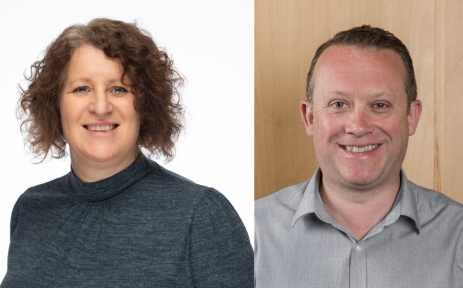
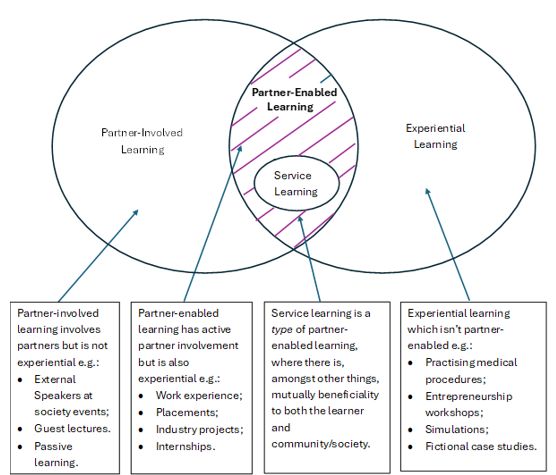
Lindsay and Phil took a paper to TLSC in April proposing a University-wide definition, criteria and typology for Partner-Enabled Learning (‘PEL’); the outcome will be shared shortly.
Behind it they have talked to over 100 colleagues, including all three Faculty TLSE Executive Committees, plus the Students' Union, Manchester City Council and Manchester Community Central (‘MACC’). They have also carried out desk-based research and had conversations with international exemplars including Cornell, Stanford and Georgia about how they roll out PEL at scale. With their student partner, they have undertaken an audit of course units in the University, with key words linked to PEL-like activity, and identified 134 courses already doing something like PEL or could be PEL with ‘tweaking’. Their student partner has carried out a focus group and is currently thematically analysing the EducateMCR survey and course unit questionnaires to give student voice to the project. Lindsay, with Rachel Lindley and others, brought the UK Service-Learning and Community-Engaged Learning Network's national conference to Manchester on 23 June, where their student partner was a keynote speaker at the event. Next, they plan to work with Faculties, Schools and Departments on where PEL fits their programmes, how PEL might be embedded so it reaches all students and how the delivery of PEL can be supported across the University.
Lindsay Bann is Student Success and Development Manager within the University Directorate for Student Experience, with responsibility for leading on a range of student development opportunities that contribute to the wider development of students alongside their formal studies, such as peer support, volunteering and Welcome, Induction and Transition. This builds on experience developed through a career within the charity sector focused on non-formal education, youth participation and young people being the agents for community change.
Dr Philip Drake is a Senior Lecturer in Law and Director of the award-winning Justice Hub at The University of Manchester. He is also a former Director of Social Responsibility for both the Law School and School of Social Sciences. He was responsible for establishing the innovative Legal Advice Clinic, based off campus in shop premises, for the University of Huddersfield in 2013. He has worked as a consultant for the University of Birmingham’s Jubilee Centre for Character and Virtues in their Virtuous Professionals Interventions Project (between 2014 and 2017); been a steering group member for a Legal Education Foundation £100,000+ funded project (between 2019 and 2021) – ‘The Law for Dementia Carers,’ and jointly led a working party to incorporate social responsibility teaching into the new law degree at Manchester. He has worked with both the University Complutense Madrid (2022-2024) and University of Southern Denmark (2019) to support clinical legal education and setting up a Legal Advice Clinic.
Shaping the projects
To ensure that each project meets the needs of our students, staff, and the University, each project was shaped with input from colleagues at all levels from across the University and taking into consideration the ongoing work to develop the Manchester 2035 strategy.
Input from across the University community was captured via in-person and online workshops, and anonymous online forums, and is available to view on Padlet.
- Input from engagement on Curriculum Interventions [opens in new window]
- Input from engagement on Service Learning (or Community-engaged learning) [opens in new window]
- Input from engagement on the Teaching-Research nexus [opens in new window]
- Input from engagement on Artificial Intelligence [opens in new window]
Thank you to all those who contributed your input and expertise to help shape these projects.
Contributor Groups
Recognising the wealth of excellent work already underway within our priority areas, ITL Fellows will play a crucial role in amplifying these efforts by connecting existing communities of practice and interest groups with the ITL Fellowship Project, creating Contributor Groups.
Contributor Groups bring together colleagues from across the University who are already working in the field or who wish to contribute, according to their capacity to do so. These groups will serve as hubs of innovation, fostering collaboration, sharing best practices, and will create lasting networks of teaching and learning excellence across the university.
If you are interested in, or are already working on, one of the key priority areas and would like to join a Contributor Group, please complete the Expression of Interest form.
Contact
For more information about the ITL Fellowship Projects and Contributor Groups, contact Antonia Acanfora or the Teaching Excellence team.
email antonia.acanfora@manchester.ac.uk or teaching.learning@manchester.ac.uk