


Representation Matters
The Representation Matters project aims to address awarding and retention gaps for disability and race at the University of Manchester by developing open access resources for inclusive and representative assessments across each academic faculty. Once complete, we will share the resources on this page.
The project employs a transformative and collaborative framework, informed by critical theories of education and pedagogy, and participatory methodologies. It will centre the voices of marginalised students and connect the theoretical and practical actions and principles that challenge notions of individual or group deficits, generating situated knowledge to transform systems instead.
Representation Matters Toolkit
The Representation Matters Toolkit translates the insights and recommendations gathered through the Disability, Race and Resource Design workshops into practical resources for staff. Developed collaboratively with students and staff, the toolkit aims to support more inclusive approaches to assessment, feedback and learning.
Access the Representation Matters Toolkit (opens in a new tab)
Project Timeline
- Planning, Scoping, and Ethics (Oct–Nov 2025)
- Participant and wider team recruitment (Nov 2025–Jan 2026)
- Workshops, Design & Resource Development (Feb 2025–June 2026)
- Resource Trial (Sept–Dec 2026)
- Evaluation & Dissemination (Oct–Dec 2026)
Outputs
Introduction to the Workshops
The Representation Matters workshop series explored staff and student experiences of assessment, accessibility, and inclusion, with the aim of informing the development of practical resources to support assessment and feedback practices.
The insights presented here were gathered through a combination of interactive workshops and individual interviews, ensuring that participants could share both collective perspectives and more personal experiences. Sessions were delivered in a hybrid format, bringing together students, academic staff, facilitators, and creative practitioners in a collaborative environment.
A participatory, peer-led approach was used throughout. Students and staff were grouped separately and supported by facilitators to encourage open and honest discussion. Alongside these conversations, live visual documentation captured key themes, connections, and emotional responses in real time. These visuals acted not only as records, but as interpretive tools that helped make complex experiences more accessible and visible.
The workshops were structured in three stages: identifying challenges, exploring solutions, and beginning the design of tangible resources. Sessions included:
- Disability 1 (Issues) – Monday, 9th March
- Disability 2 (Solutions) – Monday, 16th March
- Race 1 (Issues) – Monday, 27th April
- Race 2 (Solutions) – Thursday, 30th April
- Resource Design 1 (Outlines) – Thursday, 7th May
- Resource Design 2 (Specifications) – Monday, 11th May
Together, these activities created a structured process for moving from lived experience to practical, design-informed outputs.
Representation Matters Disability Workshop Outputs
Workshop 1: Identifying Issues in Inclusion & Representation in Student Assessment
Student Perspectives: Challenges
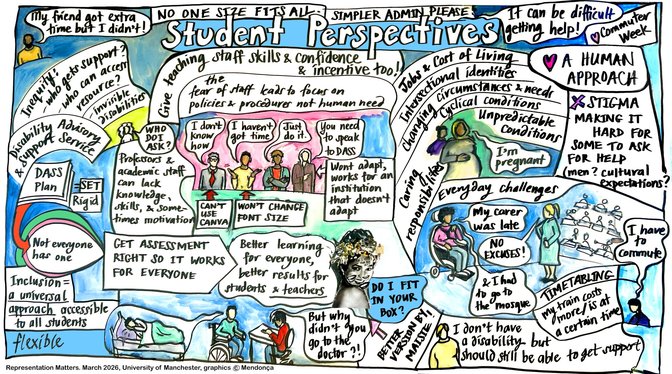
The student discussions centred on the lived realities of navigating higher education systems, particularly for students with disabilities. A strong sense of disconnect was evident between students and staff, students and support services, and within institutional processes that were often experienced as unclear or inaccessible.
Participants highlighted how standardised approaches failed to reflect diverse needs, emphasising that “one size does not fit all.” Experiences of stigma, administrative complexity, and inconsistent support were compounded by wider pressures such as commuting, financial constraints, and caring responsibilities.
Beyond practical barriers, the discussions also revealed the emotional impact of these systems, including frustration, uncertainty, and a lack of confidence in accessing support.
Staff Perspectives: Challenges
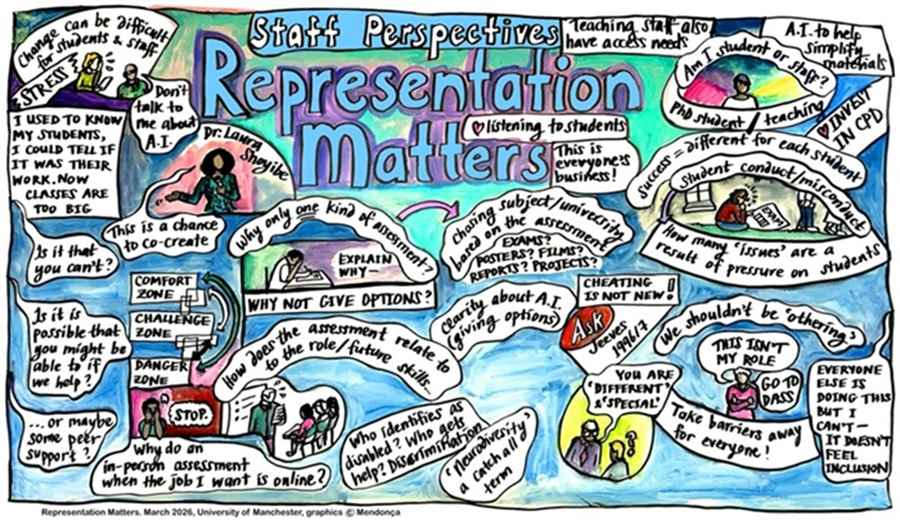
The staff discussions highlighted a complex landscape shaped by both commitment and constraint. Participants reflected on their willingness to support students, while also describing how institutional systems and processes limited their ability to act flexibly.
A key theme that emerged was a sense of disconnect from support structures, particularly in relation to navigating systems such as DASS. Staff described challenges in understanding processes, communicating effectively with support services, and confidently implementing adjustments.
At the same time, tensions were identified between maintaining academic integrity and developing inclusive assessment practices, particularly in the context of large cohorts and emerging technologies such as AI. Overall, staff perspectives revealed both a strong desire to improve and the structural barriers that shaped their practice.
Workshop 2: Generating Solutions for Inclusive & Representative Assessment
Student Perspectives: Solutions
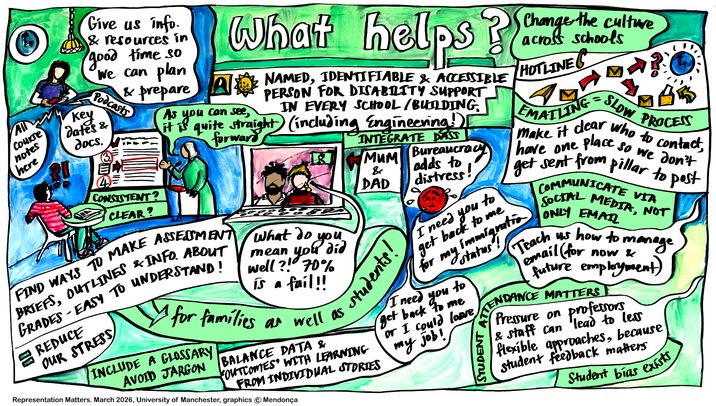
In the second stage of workshops, students focused on identifying practical, achievable improvements. Central to these discussions was the need for clearer communication and easier access to support.
One key proposal was the introduction of a centralised point of contact, enabling students to quickly understand where to go, who to speak to, and how to navigate processes. Participants also emphasised the importance of timely, consistent information, including early access to assessment guidance, key dates, and available resources.
Suggestions such as improved access to lecture recordings, notes, and opportunities for interaction were seen as ways to reduce stress and improve inclusivity. Overall, student solutions reflected a desire for simpler, more transparent systems that work effectively for all.
Staff Perspectives: Solutions
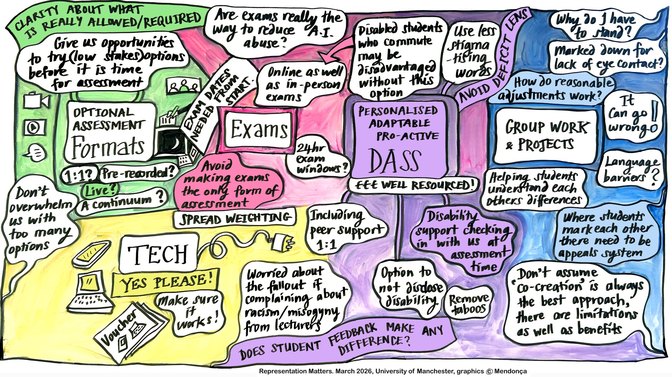
Staff responses to proposed solutions aligned closely with student priorities, while also highlighting the importance of balance and careful implementation. In particular, participants emphasised the need for structured flexibility, ensuring that assessment choices were meaningful without becoming overwhelming or inconsistent.
There was a strong focus on providing clear, detailed, and timely guidance to support student understanding and preparation. Staff also reflected on the importance of shifting away from a deficit-based view of disability, advocating instead for approaches that recognise student strengths and promote inclusive learning environments.
Overall, staff perspectives highlighted the need for clarity, consistency, and a more holistic approach to inclusion, supporting both students and educators in navigating assessment more effectively.
Representation Matters Race Workshop Outputs
Workshop 3: Identifying Issues in Inclusion & Representation in Student Assessment
Student perspective: challenges
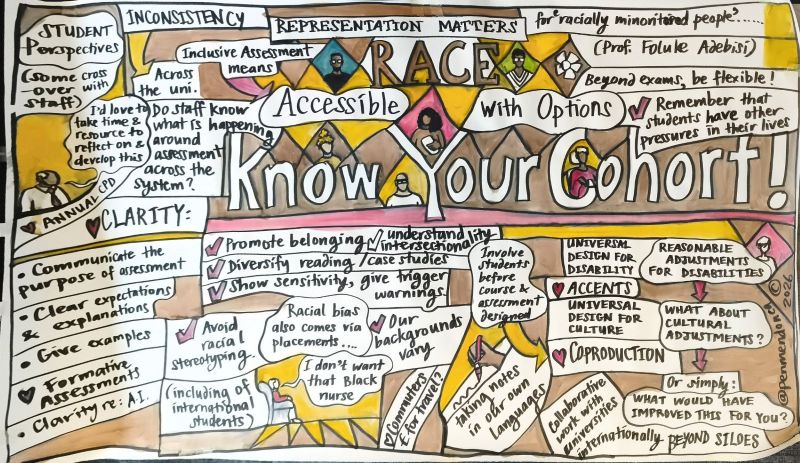
The student discussions centred on how race shapes identity and everyday experiences at university. Students reflected on the complexity of navigating multiple aspects of their identity and highlighted the importance of recognising intersectionality within learning and assessment.
Accessibility in assessment was a key theme, particularly in relation to in-person examinations. Students also raised concerns about bias linked to accent and communication style in presentations, oral assessments and vivas, noting that Western communication norms are often treated as the default and that reports of discrimination do not always lead to meaningful action.
Staff perspective: challenges
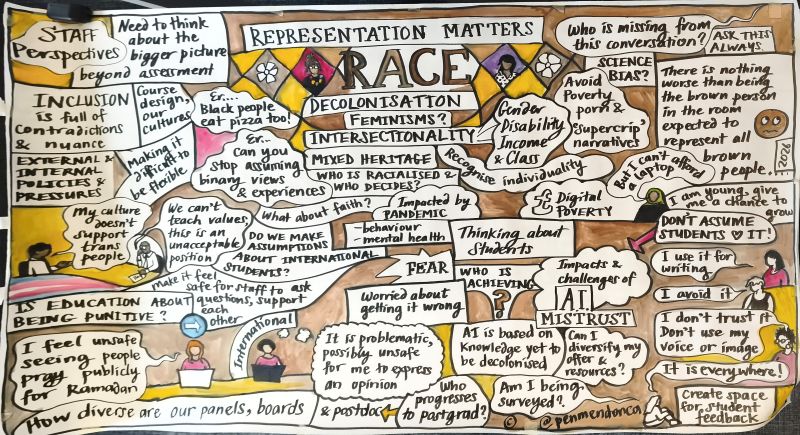
The staff discussions centred on how identity can shape experiences in both higher education and the workplace. Discussions highlighted the impact of digital poverty, the importance of meaningful representation, and the need to ensure that students and staff feel genuinely heard and included.
Staff also reflected on the conditions needed to support equity and inclusion, including opportunities for honest feedback, time to review and improve courses, and effective ways to evaluate whether institutional initiatives are having a positive impact.
Workshop 4: Generating Solutions for Inclusive & Representative Assessment
Student perspective: solutions
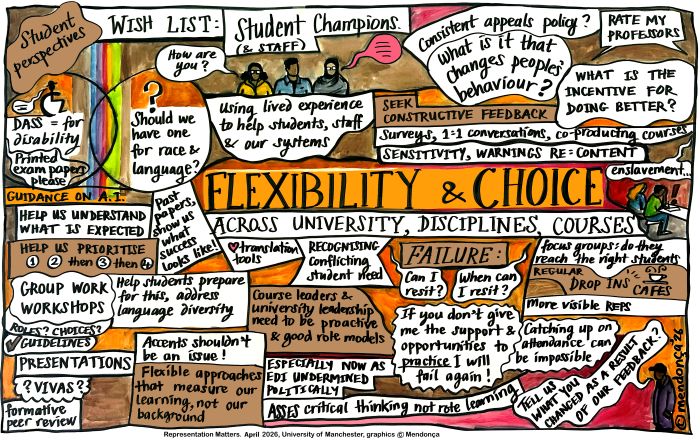
In the second stage of the workshops, students focused on practical and achievable improvements to assessment and the wider student experience. A strong emphasis was placed on greater consistency across departments, clearer assessment guidance, and increased transparency in university processes.
Students proposed a range of solutions, including tailored support for international students, more diverse marking panels, and the consistent use of content warnings across programmes. Discussions also explored ways of increasing accountability and transparency within teaching and assessment, while recognising the need for appropriate safeguards.
Staff perspective: solutions
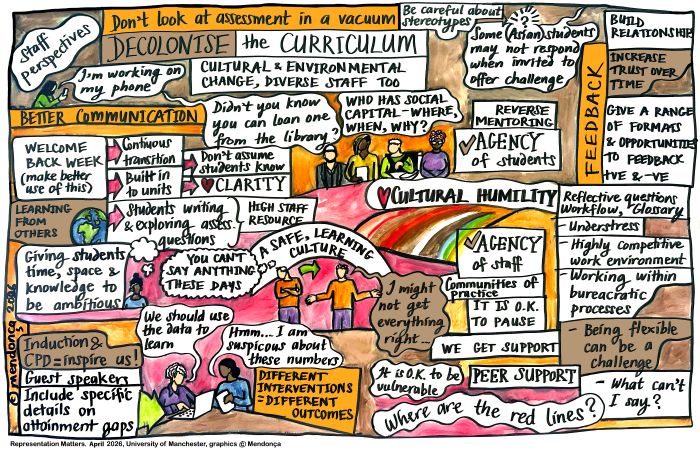
In the second stage of the workshops, staff reflected on practices they wanted to stop, start and continue in order to create more inclusive learning environments. Discussions highlighted the importance of moving away from complacency and creating space for vulnerability, reflection and honest conversations about equity and inclusion.
Staff expressed a desire to strengthen cultural humility through professional development, share decision-making and agency more openly, and engage in partnership with students by acknowledging that staff do not have all the answers. Participants also emphasised the value of maintaining relationship-centred approaches, fostering stronger disciplinary communities, and continuing initiatives such as PASS and peer mentoring that support connection and belonging.
Representation Matters Resources Workshop Outputs
.png)
Workshop 5: Co-developing the Resources
The first Resource Development Workshop brought students and staff together to collaboratively develop an assessment timeline that reflected the student journey across the academic year. Building on themes identified in previous workshops, participants shared experiences, explored challenges, and identified opportunities for improvement.
Using a creative and open-ended approach, students and staff worked in partnership to map key moments in the assessment process, contributing practical suggestions, reflections and examples of support. The workshop highlighted the value of collaborative problem-solving and demonstrated how bringing together different perspectives can strengthen the development of inclusive resources.
-resized.jpg)

Workshop 6: Shaping the Final Resource
The second Resource Development Workshop focused on reviewing and refining the format of the final resource. Students and staff explored a range of infographic designs and provided feedback on elements such as layout, colour, typography and accessibility.
Discussions emphasised the importance of creating a resource that was both visually engaging and accessible to a wide range of users. Participants considered how design choices could support inclusion, ensuring that the final resource would be easy to navigate, meaningful to students, and effective in communicating key information.
Student Reflections
Reflection Matters: A Reflective Blog on Disability Workshops
Student Partner Alayna Kondamudi reflects on the Representation Matters disability workshops, exploring themes of accessibility, communication, inclusion, and the value of student-staff dialogue in shaping assessment practices. Read the blog here!
Reflection Matters: A Reflective Blog on Race Workshops
Student Partner William reflects on the Representation Matters race workshops, exploring themes of identity, representation, belonging, and bias in assessment, alongside opportunities for creating more inclusive learning environments. Read the blog here!
Reflection Matters: Developing Resources that Matter
Student Partner Alayna Kondamudi reflects on the Resource Development Workshops, exploring how students and staff worked together to co-create inclusive assessment resources through collaboration, creativity, and shared experiences. Read the blog here!
Project Team
- Co-PIs: Prof Hannah Cobb, Academic Lead for Academic Development and Professor of Archaeology and Prof Gabrielle Finn, Pro Vice-Chancellor (Education) at Northumbria University, Medical Education and an Honorary Professor at the University of Manchester
- Research Associate: Dr Laura Shobiye
- Project Support: Raluca-Elena Valcescu
- Student Partners: Alayna Kondamudi, William Odumosu and Carl Kulimushi
How to find out more?
To find out more about the project, please contact Laura at laura.shobiye@manchester.ac.uk or on +44 161 306 2968.