


Service excellence in action: capturing attendee data with visitor scanning
12 Jan 2026
By introducing visitor scanning at open days, the Humanities Marketing and Student Recruitment team has enabled attendance data capture and enhanced the application experience for students. Elizabeth McCullough from the team explains more.
Situation
For large-scale events like open days, we know that we won’t achieve 100% attendance – lots of people register but are then unable to attend. Capturing accurate attendance information enables us to manage space and services on campus so that we provide for the number of people coming to campus, for example, ensuring that enough catering outlets are open to meet demand.
Attendance data also helps us find out more about who is coming and enables us to identify patterns in visitor behaviour. For example, students who book nearer the date of the open day are more likely to attend, so focusing event promotion activity closer to an open day will provide a better return on marketing spend. We can also recognise postcode hot/cold spots which we can map against applicant data to better understand whether or not open days are attracting students from the same (or different) postcode areas to those of applicants.
Most universities have been capturing attendance data at open days for a number of years – this was an area of work where we needed to catch up with the sector norm.
Action
Undergraduate open days are organised by the University’s central Marketing team, so we liaised with them to make them aware of what we intended to do. Our activity served as a good pilot project to see how scanning could work in practice. We also contacted marketing counterparts at the University of Sheffield to find out how they organised and managed visitor scanning at their events – they have done open day scanning since 2022 on a similar scale to Manchester’s open days.
We needed to consider visitor flow into buildings – we wanted to avoid bottle-necks and long queues forming of people waiting to be scanned, and we also had to ensure that all the entrances to a building had a welcome desk/scanning desk so nobody was missed. To ensure we had enough capacity to scan, we released a call-out to PS colleagues from Schools and the Faculty Office to support at the open days.
We delivered staff training sessions and produced step-by-step instructions so that staff were confident and comfortable using the scanning software, and hired iPads to ensure we had enough devices to complete the scanning.
To avoid visitors being asked to scan their open day QR code every time they went into a building, we developed a code – if a visitor had a bee sticker or tote bag, that was the sign that they had been scanned.
Result
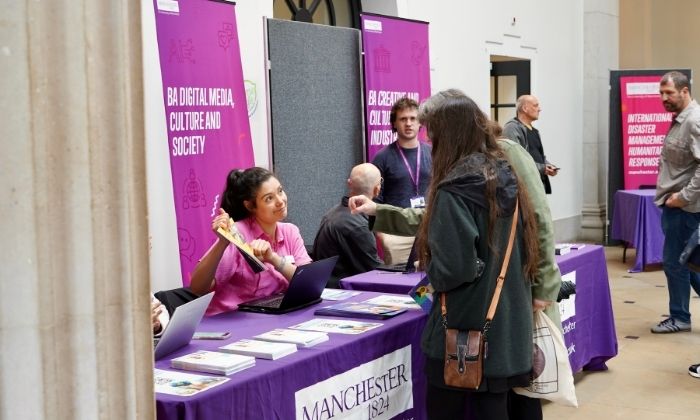
Scanning enabled us to provide an even warmer welcome to visitors than usual! Once we scanned a QR code, we saw the person’s name and the subject they were interested in, enabling us to use this in conversation and guide them to the relevant subject talks and exhibitions. Building this rapport also increased footfall to the welcome desks – once someone had been to a subject stand/talk, they were more likely to come back to the welcome desk to enquire about finding campus tours or accommodation.
Manchester is a city-centre campus and our buildings are very open, meaning visitors can have concerns that just anyone can come onto campus. These concerns were heightened following the attack on the Heaton Park synagogue, which happened immediately before the October open days. Visitors felt reassured that we were asking to see open day QR codes and scanning people in.
Martyn’s Law is new legislation that is designed to improve the security of any venue hosting events and venues have two years to comply. By introducing the open day scanning now, we are already implementing measures that are aligned to the legislation.
Having the attendance data has also put us in a much better position for post-event communications, as email content and messaging can now be tailored to the students who came to open days, as well as to those who didn’t attend.
The attendance data has enabled us to scrutinise and analyse the registration data – we are identifying duplicates (students who registered multiple times using different email addresses) and whether or not they came to an open day. The attendance data has also shown how many students are still choosing between subjects before they come to an open day. Sometimes these decisions are between closely related subjects, e.g. economics or accounting, but sometimes the subject choices are very diverse, e.g. art history or architecture.
We really enjoyed working with PS colleagues from other teams who joined the open days to support. During quiet times, it was good to talk to colleagues and find out more about their role at Manchester and the team they work in, which added to our understanding of the services and support provided to current students.
Want to find out more?
Email Elizabeth McCullough or James Rawlinson to find out more about visitor scanning.
Share your service excellence story
If you would like to share your or your teams examples of service excellence, please complete our short form.