


ITL Fellowship Projects
We are delighted to announce the appointment of eight new ITL (Institute of Teaching and Learning) Fellows.
Starting in September 2025, ITL Fellows have been appointed to lead projects in key priority areas. The aim of these projects is to deliver a sustainable change across four strategic priority areas within teaching and learning. The priority areas are:
- The Teaching-Research nexus
- Curriculum interventions for student success
- Partner-enabled learning
- Artificial intelligence in teaching and learning
About the projects
Fellows are expected to deliver a change that provides a tangible benefit to our students. To that end, appointed Fellows have been supported in embedding a Theory of Change approach from the outset, ensuring concrete action plans and continued evaluation to support effective implementation with impact. This approach ensures that projects have clear goals, measurable outcomes, and a robust framework for evaluating their impact on student experience and learning.
Projects will run for two years with Fellows working on up to 0.4FTE per-week on a given project. Each project is also supported by a paid Student Partner, helping to ensure the Student Voice is central the project from the outset. Fellows were appointed following a competitive application and interview process.
Meet the ITL Fellows (2025-27)
The Teaching-Research Nexus
Jennifer O’Brien

Professor Jennifer O’Brien NTF, PFHEA is Academic Lead for Sustainability Teaching and Learning at the University of Manchester, the Founder and Director of the University Living Lab, and the Skills (education) Lead for Sustainable Futures. Jen’s Fellowship critically considers how students learn by researching to the benefit of multiple priorities.
The interdisciplinary University Living Lab links applied research needed by organisations with students who can undertake it for their assessment to effect change and contribute to the United Nation’s Sustainable Development Goals. Working with the University's Sustainable Futures initiative, and leaning into Partner-Enabled Learning, Jen's Fellowship will scale the University Living Lab with Student Voice and students’ priorities for sustainable development. Alongside other good practice, the University Living Lab becomes a lens through which to consider how we can enhance research and innovation, social responsibility, teaching excellence, accessible student experiences and employability, as students undertake research as a core part of their learning.
A Development Geographer by training, Jen works with Education for Sustainable Development to inspire and equip learners to ethically address challenges of sustainability, inequality and social justice to affect positive change.
Cristina Masters

Dr Cristina Masters SFHEA is a Senior Lecturer in International Politics (Department of Politics, School of Social Sciences) and is Programme Director (Politics MA). She is also the School of Social Sciences Lead for the Humanities New Academics Programme (HNAP). Cristina is a Senior Fellow of Advance HE and has a PG Certificate in Higher Education.
‘Research-led teaching’ is an often-heard claim at research-intensive universities. It appears in promotion applications, in statements on teaching and in everyday academic conversations, and it is delivered as though what is meant by ‘research-led’ teaching is not only taken as obvious and uncontested, but also as necessarily ‘good’. Cristina's Fellowship project aims to critically probe at what is meant by research-led teaching and challenge its unidirectional orientation where classrooms are perceived as spaces to impart research expertise and knowledge.
There are several potential effects that can be identified from this orientation:
- recentres the researcher in teaching and learning
- reproduces the hierarchy between research and teaching already evident in research-intensive environments
- reproduces the sense that research is something that happens outside the classroom and the classroom as a site where students learn and teachers teach, and not necessarily as spaces where expertise and knowledge is also, and importantly, created for researchers.
With the intention of working toward developing the ‘nexus’ in the teaching-research nexus, the project will endeavour to ask and answer the following questions:
- What does good research-led teaching look like?
- Who is research-led teaching good for?
- Should pedagogical research inform good research-led teaching?
- When is it appropriate to engage in research-led teaching?
- What does teaching-led research look like?
The goal of the project is to participate in enhancing the environment of Teaching Excellence at the University of Manchester through a mutually constitutive approach to teaching and research that can benefit and enrich both students and academics.
Curriculum interventions
Sarah Hatherill

Dr Sarah Hatherill SFHEA, PGCert HE is a Senior Lecturer in Physiology at the University of Manchester and Programme Director for the Biosciences Foundation Year. Sarah's interests include student belonging, differential attainment and how effective curriculum design can promote student success.
A sense of belonging and feeling that one truly matters are fundamental to student success. Through the Curriculum Interventions for Student Success Project, we are exploring how to create a more holistic and interconnected student experience; supporting student success, and wellbeing, throughout the academic journey by recognising that we need to meet students where they are, rather than where we assume or hope they may be.
Our aim is to understand how students access support, develop skills, and engage with flexible learning opportunities across their programme of study, as well as the barriers or challenges they may encounter. This insight will enable us to improve institutional structures and practices to deliver positive outcomes for all.
Initial work is exploring how the information and systems we use to support students can be more effective. By ensuring that relevant information is available when needed, we can make interactions with students more meaningful and provide timely, personalised support throughout their academic journey.
We are actively growing our contributor group, a collaborative network for all colleagues to share ideas and projects related to teaching and learning enhancement to improve student outcomes. This group will be a space for discussion, idea generation and co-development of approaches that inform institutional strategies from the ground up. If you are interested in getting involved, please join us. You can register your interest and sign-up to receive updates about upcoming meetings and events by contacting antonia.acanfora@manchester.ac.uk.
Artificial intelligence in Teaching and Learning (learning, training and policy)
Skye Zhao

Leveraging the Library as a Safe Space to Build AI Competency for Students and Staff
Generative AI is rapidly reshaping higher education by enhancing productivity, supporting diverse learners, and transforming teaching and learning practices. However, concerns about academic integrity, misinformation, and varying approaches to AI integration have created uncertainty and mistrust between students and staff. In response, universities must foster open dialogue, shared understanding, and confidence in the responsible use of AI.
This ITL project positions the University of Manchester Library as a safe, non-judgmental space where students and staff can openly explore their AI practices, questions, and concerns. The initiative will enable participants to reflect critically on their use of GenAI and develop the skills needed for ethical, confident, and informed engagement with AI tools.
Led by Dr Skye Zhao, Lecturer in Generative AI for Education at the Manchester Institute of Education, the project draws on global insights gathered in collaboration with UNESCO on AI competency needs in higher education. These insights will inform the design of a reflective toolkit to guide open dialogue and self-reflection on AI use. The toolkit will be piloted and refined through focus groups with students and staff to ensure it is effective, inclusive, and scalable across the University and beyond. Key outcomes include: a scalable programme for using university libraries as safe, trusted spaces for AI competency development; a reflective toolkit to support ethical and critical engagement with AI; online learning resources showcasing responsible and problematic AI practices in learning and teaching.
As AI reshapes education worldwide, universities need approaches that are inclusive, supportive, and grounded in mutual trust. By positioning the library as a hub for reflection and dialogue, this initiative will help build shared understanding, reduce fear and stigma around AI use, and enable both students and staff to develop the competencies needed to thrive in a digital society.
Dr Xin Zhao (Skye) is a Lecturer in GenAI for Education at the Manchester Institute of Education. She is a partner with UNESCO, leading a global initiative reviewing the adoption of AI competency frameworks across higher education institutions. Dr Zhao also serves on the AI Expert Panel for the United Nations. She is a Senior Fellow at the Microsoft AI Economy Institute, where she explores global AI skills diffusion.
Mark Carrigan

This project starts from a simple premise: generative AI has already happened. Three years after ChatGPT’s launch more than 90% of undergraduates are using these tools yet the sector too often acts as if preparing for a future change rather than navigating a present reality. The core challenge is not the absence of policy but the gap between policy and practice. In large, centralised institutions, strategies are often detached from the lived realities of teaching and learning. Meanwhile, staff confront everyday uncertainty: here, now, with these students, what should I be doing? There’s an urgent need to support learning and scholarship across the university in a way which links up the innovation already taking place in particular areas.
The AI Commons provides a platform for scholarship that addresses this challenge by creating conditions for dialogue rather than prescribing solutions. It has four interlocking strands: a blog, a podcast series, cross-faculty workshops, and an AI training agent. These are designed to surface practice, share experience, and build the communities of judgement universities now need. The goal is to help universities develop a situated, collective understanding of what effective and appropriate use of generative AI means and how we can navigate that together. It provides a platform for scholarship which enables us to join up the innovation taking place already.
This means catalysing learning networks that are lightweight enough to gain traction with busy colleagues, yet robust enough to generate shared norms and sustainable institutional change. It seeks to create the conditions for innovation by identifying and amplifying the work already underway, connecting innovative colleagues across disciplines and supporting accessible forms of professional development that enable all staff to engage meaningfully with these challenges. The ultimate goal is a durable learning community at the University of Manchester capable of sustained development and adaptation as generative AI continues to reshape higher education.
Dr Mark Carrigan (FRSA FHEA) is a Senior Lecturer in Education at the University of Manchester, where he co-leads the Digital Education Manchester group and serves as an AI Fellow at the Institute for Teaching and Learning. He has written or edited ten books, including Social Media for Academics and Generative AI for Academics. His latest book, Platform and Agency: Becoming Who We Are, develops a conceptual framework for understanding personal transformation in the digital age.
Elizabeth Lewis

This project supports staff as they navigate the rapidly changing context created by generative AI. Colleagues across the University are exploring what this technology means for their own subjects and teaching practices. Because there is no one-size-fits-all approach, the project focuses on creating supportive spaces where interested colleagues can share and explore ideas and innovate safely.
The first stage involves light-touch mapping of emerging practice: how colleagues are teaching students to use AI productively, how academic integrity is being approached in AI-rich settings, and how staff are incorporating AI into their own workflows. Building on this, the project will bring together colleagues working on similar questions through co-creation events and hackathons. These sessions will support the development of new ideas and enhance the reach and impact of work that is already underway.
To support this work, the project will experiment with human-centred uses of AI to help colleagues share insights, identify common themes, and develop ideas together. These same processes will help refine and co-create practical AI tools—developed with staff and students—that can be integrated into teaching in lightweight and sustainable ways. Across all activities, the emphasis is on fostering resilient, human-centred teaching and learning that retains its value as the technological environment evolves.
Dr Elizabeth Lewis (SFHEA) is a Senior Lecturer in the Division of Psychology and Mental Health in the School of Health Sciences. She is a Senior Fellow of Advance HE with a particular interest in pedagogic innovation, student engagement, and the enhancement of teaching practice.
Partner-enabled learning
Philip Drake and Lindsay Bann

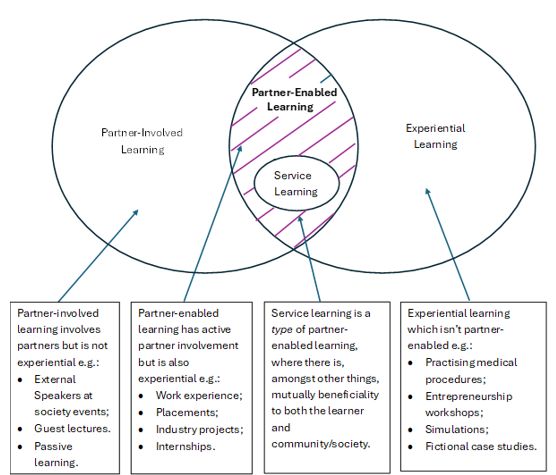
Currently a range of terms are being used across the university around ‘Partner-Enabled Learning’ (‘PEL’), which are interconnected but not necessarily interchangeable. It is important to consider the nuances related to these terms to better understand how they work together and what we mean, as a university, by the concept of ‘Partner-Enabled Learning’. The diagram below demonstrates some of the interconnected concepts and how they relate to each other, with examples of the different types of activities related to each concept in the boxes below.
‘Partner-enabled learning’ lies at the intersection of ‘Partner-involved learning’ and ‘Experiential learning’. Whereas ‘Service-learning’ is a type of ‘Partner-enabled learning’.
For the purposes of our ITL project, we are focusing upon ‘Partner-enabled learning’ activities such as (but not limited to): service-learning, work experience, placements, industry projects, internships etc.
We are currently undertaking a topography of current PEL offerings at The University of Manchester, in order to map out current provision.
We are also examining the criteria for ‘Partner-enabled’ activities, including if they should be:
- Experiential and active (rather than passive);
- Clearly structured with intended learning outcomes;
- Embedded into the curriculum;
- Offered as a core/compulsory credit-bearing activity on all programmes; and/or
- Have reflection integrated and tied into the activities and intended learning outcomes in order to demonstrate both micro, meso and macro levels of understanding and self-awareness and self-development.
As part of our project, we will be working on a short term (1-3 years), medium term (4-6 years) and long term (7-10 years) strategy for the implementation of PEL across the University, in line with the Manchester 2035 vision.
Lindsay Bann is Student Success and Development Manager within the University Directorate for Student Experience, with responsibility for leading on a range of student development opportunities that contribute to the wider development of students alongside their formal studies, such as peer support, volunteering and Welcome, Induction and Transition. This builds on experience developed through a career within the charity sector focused on non-formal education, youth participation and young people being the agents for community change.
Dr Philip Drake is a Senior Lecturer in Law and Director of the award-winning Justice Hub at The University of Manchester. He is also a former Director of Social Responsibility for both the Law School and School of Social Sciences. He was responsible for establishing the innovative Legal Advice Clinic, based off campus in shop premises, for the University of Huddersfield in 2013. He has worked as a consultant for the University of Birmingham’s Jubilee Centre for Character and Virtues in their Virtuous Professionals Interventions Project (between 2014 and 2017); been a steering group member for a Legal Education Foundation £100,000+ funded project (between 2019 and 2021) – ‘The Law for Dementia Carers,’ and jointly led a working party to incorporate social responsibility teaching into the new law degree at Manchester. He has worked with both the University Complutense Madrid (2022-2024) and University of Southern Denmark (2019) to support clinical legal education and setting up a Legal Advice Clinic.
Shaping the projects
To ensure that each project meets the needs of our students, staff, and the University, each project was shaped with input from colleagues at all levels from across the University and taking into consideration the ongoing work to develop the Manchester 2035 strategy.
Input from across the University community was captured via in-person and online workshops, and anonymous online forums, and is available to view on Padlet.
- Input from engagement on Curriculum Interventions [opens in new window]
- Input from engagement on Service Learning (or Community-engaged learning) [opens in new window]
- Input from engagement on the Teaching-Research nexus [opens in new window]
- Input from engagement on Artificial Intelligence [opens in new window]
Thank you to all those who contributed your input and expertise to help shape these projects.
Contributor Groups
Recognising the wealth of excellent work already underway within our priority areas, ITL Fellows will play a crucial role in amplifying these efforts by connecting existing communities of practice and interest groups with the ITL Fellowship Project, creating Contributor Groups.
Contributor Groups bring together colleagues from across the University who are already working in the field or who wish to contribute, according to their capacity to do so. These groups will serve as hubs of innovation, fostering collaboration, sharing best practices, and will create lasting networks of teaching and learning excellence across the university.
If you are interested in, or are already working on, one of the key priority areas and would like to join a Contributor Group, please complete the Expression of Interest form.
Contact
For more information about the ITL Fellowship Projects and Contributor Groups, contact Antonia Acanfora or the Teaching Excellence team.
email antonia.acanfora@manchester.ac.uk or teaching.learning@manchester.ac.uk