


-(65-×-25in)-(65-×-20in)-3-1.jpeg)
The University of Manchester Teaching and Learning Conference 2026
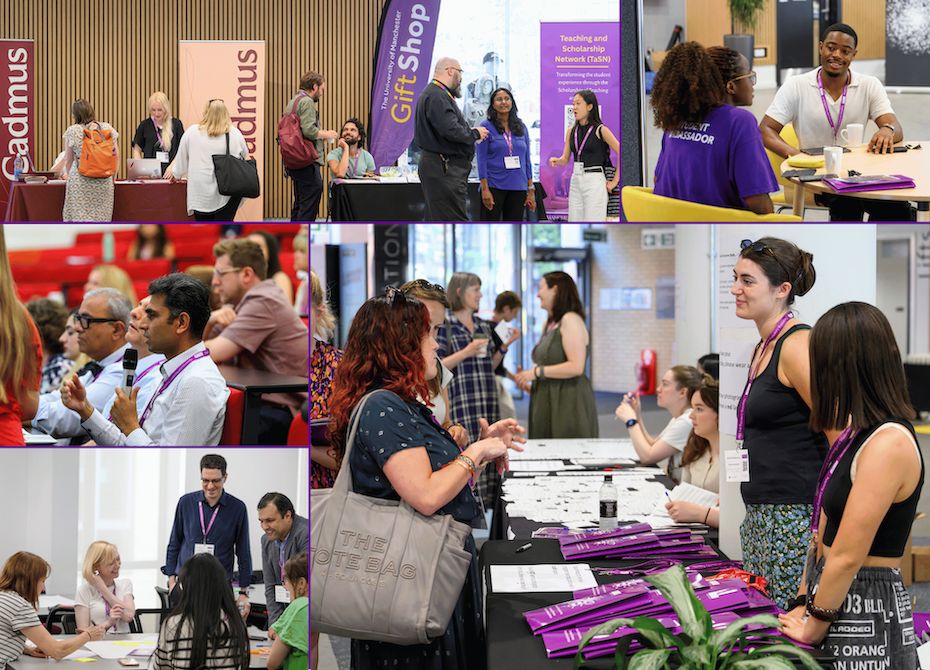
The University of Manchester Teaching and Learning Conference 2026 was a successful and engaging two-day event that brought together staff and students to explore current developments in teaching and learning.
The conference centred around three key themes: Research-informed Teaching and Learning, Teaching and Learning as Innovation, and Social Justice in Teaching and Learning. These themes provided a platform for colleagues to share practice, exchange ideas, and reflect on approaches to enhancing teaching and learning across the University.
Attendees took part in a diverse programme of Wicked Problem Sets, Lightning Talks, Poster Presentations, and Standard Paper Presentations, creating a vibrant environment for collaboration, discussion and knowledge exchange.
The conference offered valuable opportunities for learning, networking and collaboration, inspiring participants to continue developing and enhancing teaching and learning across the University of Manchester and beyond.
Wednesday - Plenary 1: Teaching and Learning Through Research: Moving Towards a Partner Enabled Learning Approach?
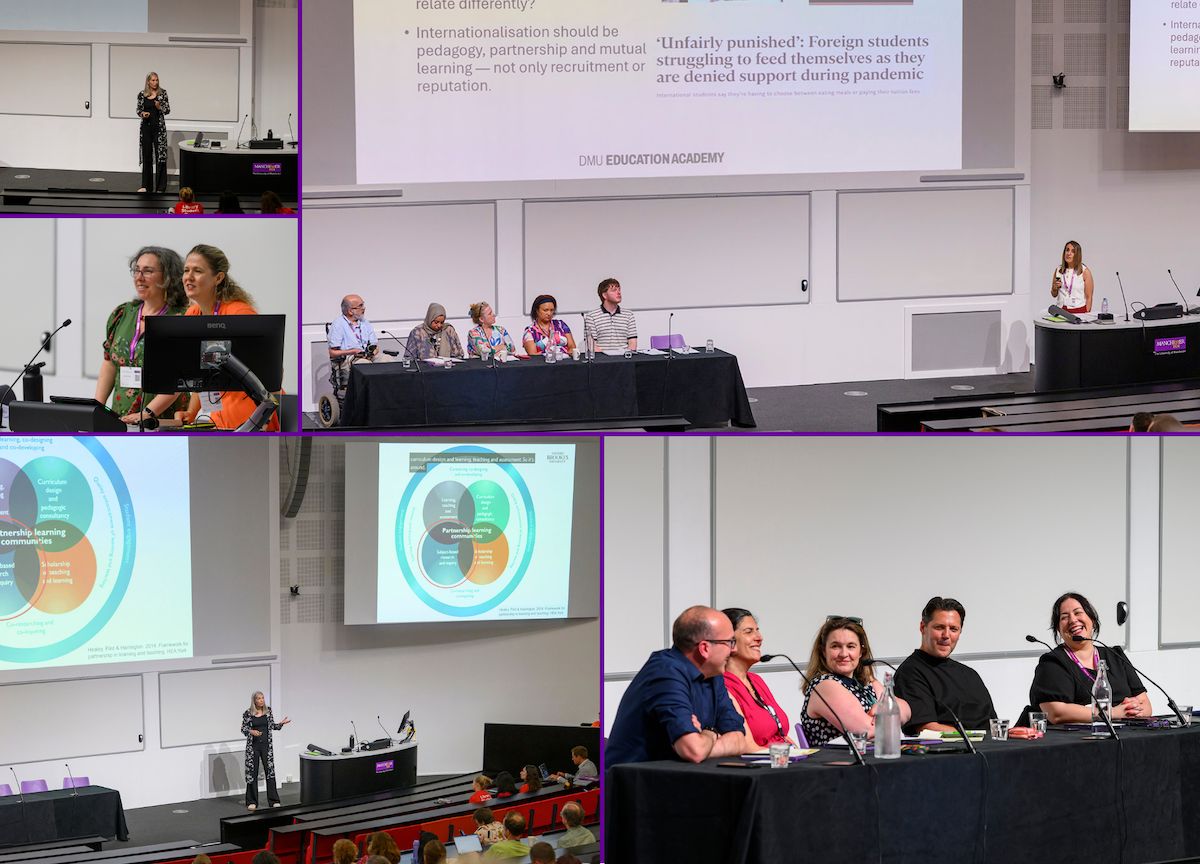
The first Plenary session of the conference explored Teaching and Learning Through Research As a Key Driver of Student Engagement, Wellbeing and Partnership. Led by Professor Helen Walkington (Oxford Brookes University), alongside a panel of contributors, the session examined how research-inclusive education can empower students to become active participants in knowledge creation throughout their academic journey.
The discussion centred on embedding authentic research experiences across the curriculum, positioning students as researchers and partners in learning. Key themes included the benefits of enquiry-based learning for student confidence and wellbeing, the importance of mentoring and inclusive research opportunities, and the value of creating meaningful pathways for students to share their work through conferences, journals and other forms of dissemination. The session also highlighted how research-informed teaching, authentic assessment and collaboration with external partners can strengthen employability, foster a sense of ownership, and create a more inclusive and impactful learning experience for all students.
Thursday - Plenary 2: Social Justice in Teaching and Learning
The second plenary session of the conference explored Social Justice in Teaching and Learning, challenging attendees to reflect on how higher education can move beyond aspirations of inclusion towards meaningful structural change. Led by Dr Hardeep Basra (Head of Educational Development, De Montfort University), the session was followed by a panel featuring Alec Severs, Dr Sadia Habib, Dr Laura Shobiye, Dr Hamied Haroon and Professor Rachel Cowen, bringing together student, academic and professional perspectives on equity and belonging.
Dr Basra encouraged delegates to consider social justice as a foundation for teaching and learning rather than an additional consideration, raising critical questions about power, representation and whose voices are valued within higher education. The panel brought together academic, professional and student voices to share perspectives on inclusion, belonging and lived experiences. The discussion explored the importance of compassionate pedagogy, decolonising practice and institutional responsibility in creating learning environments where all students feel recognised and supported.
Thursday - Plenary 3: Innovation in Action – Reimagining the Student Experience
This plenary session explored how teaching and innovation can work together to shape the future student experience at The University of Manchester, aligned with the ambitions of Manchester 2035. Led by Professor Jenn Hallam (Vice-President for Teaching and Learning) and Professor John Holden (Vice-President for Innovation), the session examined how partner-enabled learning, entrepreneurship education, interdisciplinary collaboration and challenge-led teaching can prepare students to thrive in a changing world.
The discussion highlighted the importance of creating a culture where learning, research and ideas can translate into real-world impact. Speakers explored how partnerships, innovation and new approaches to education can empower students as active contributors to society, while strengthening the University’s role in addressing global and local challenges.
Standard Papers
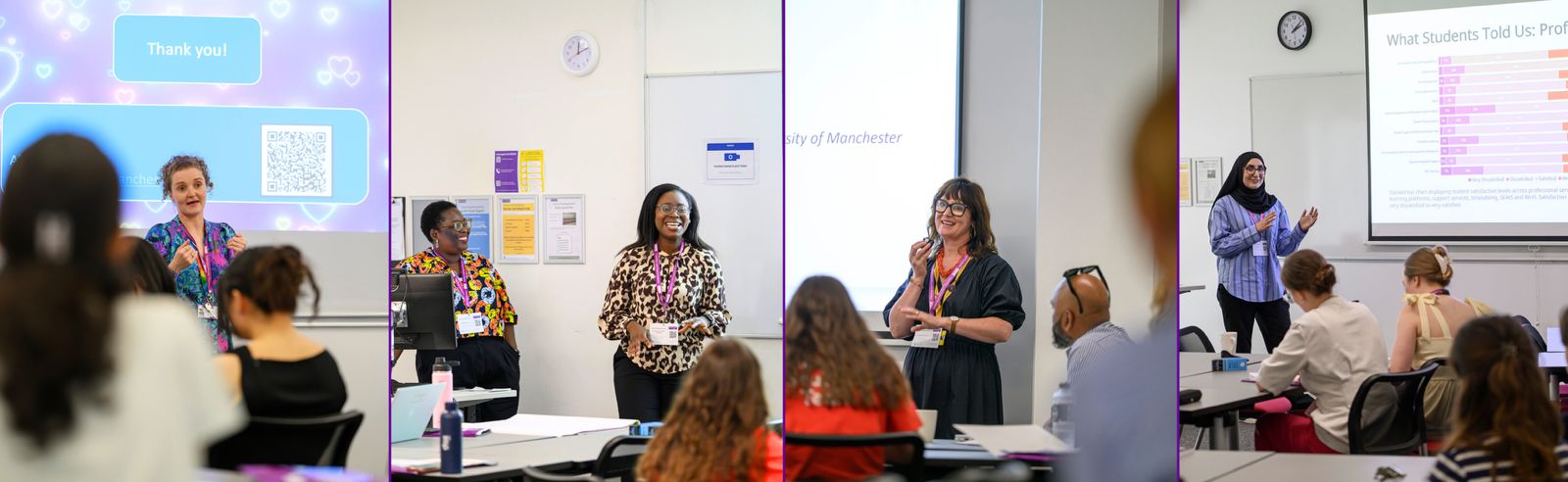
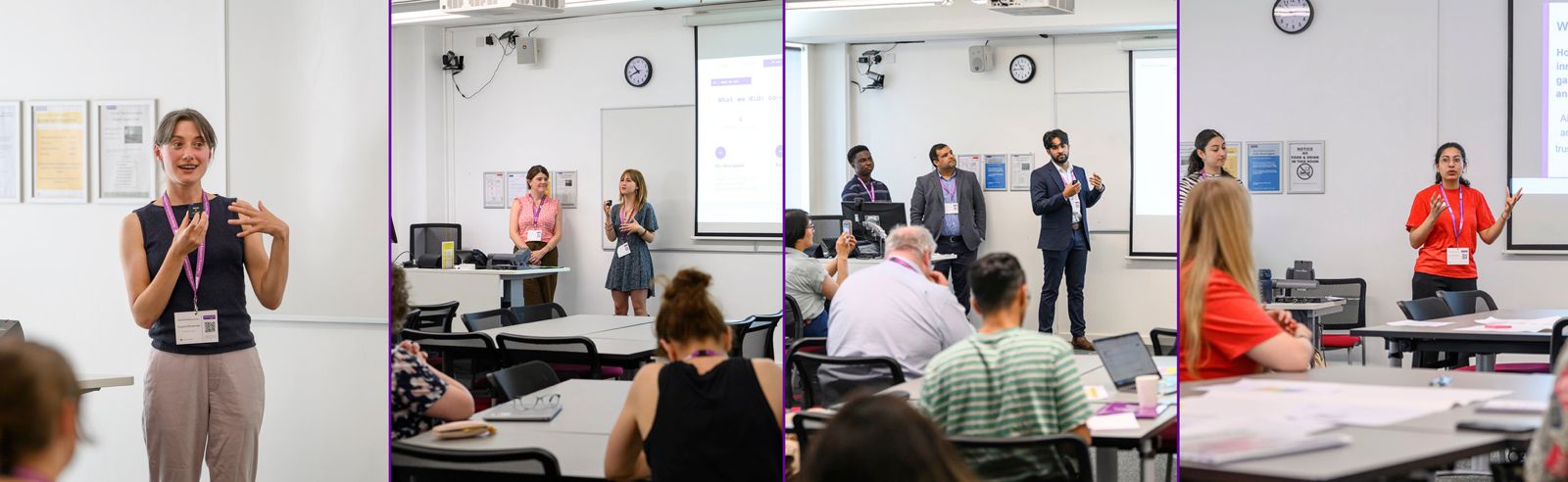
Standard Paper Presentations covered a broad spectrum of topics across key areas of Teaching and Learning, including innovations in assessment and feedback, interdisciplinary teaching, the role of generative AI in Higher Education, curriculum approaches that support diverse Student Experiences, and initiatives addressing access, inclusion, and belonging. The presentations sparked rich discussions among attendees, encouraging the exchange of ideas and inspiring reflection and action in Teaching and Learning across Higher Education.
Day 1
Standard Papers: VR and Gamification for Employability and Learning
Eating, drinking & swallowing clinical competencies and virtual reality simulation
Hawra'a Abid, Jack Delaney & Rachel Purcell
Standard Papers: Working with Partners (PEL) and Communities
Innovations in Patient and Public Involvement (PPI) in Education
Yvonne Awenat
Teaching the Circular Economy Through Community-Embedded Learning
Lindsay Pressdee, Jo Conlon & Amy Benstead
Co‑Created Learning Through Lived Experience and Partner Engagement
Sarah Knighton, Harsha Parmar, Sadia Ibrahim, Eisha Mughal, Aseel Said, Amna Syed
Standard Papers: Transition, Induction and Equity
Co-Creating inclusive transition pathways for widening participation applicants in Biosciences
Maria Canal, Lisa Swanton, Grace Gibbons, Emily James, Bethan Stones
Co-creating Academic Induction
Catherine Collin
Standard Papers: The Research-Teaching Nexus
Research-led teaching::teaching-led research
Christina Masters
Research-Informed Curriculum Mapping: Bridging Transferable Skills Theory and Assessment
Zhiteng Feng, Tatiana Martinez, Sally Gee, Na Zuo
Interdisciplinary research and teaching in international business courses
Xia Han
Standard Papers: Students as research partners
Combatting the 'Turnitin Abyss' through a student led virtual conference
Aadya Gupta, Zoe Phillis, Alexandra Nickel, Jen O'Brien
Harsha Parmar, Masuma Sajedah, Kennedy Osaseri Junior, Stephanie Okoro, Hermela Weldegerges and Sarah Knighton
Embedding Social Justice in Fashion Education
Lisa Taylor, Aurelie le Normand, Lia George
Standard Papers: Assessment and Feedback Transparency and Literacy
Building Assessment Literacy in Higher Education using Peer Marking
Hannah Wilkinson
Rachel Ashworth, Ruth Ingram and Elizabeth Lewis
Enhancing Feedback Literacy to Improve Student Engagement with Feedback
Samantha Durrant, Jenny Freed
Standard Papers: Building Belonging
Reimi Sivalingam, Sarah Hatherill, Aurelie Le normand, Barbara Waters, Nooch Kuasirikun, Scott Midson, Hamza Badenjiki & Ruitong Wang
Oluwatoyin Dosumu; Oluwaseun Olabode
Enhancing Student Belonging and Mattering: Key Role of Academic Advisor's Attitude & Flexibility
Amir Rahbarimanesh
Standard Papers: Reflection, Coaching and Assessment Guidance
Rebecca Phillips, Andrew Rhodes, Liz Birchinall
James Brooks
Using spoken word poetry to transform reflective practice
Emmanuel Oladipo, Esther Boyede
Standard Papers: Visibility, Inclusion and Equity
Non-visibility of LGBTQ+ UK University Classrooms
Stephen Doyle
Constructing the Inclusive Classroom: Narratives of Disabled and Neurodivergent Students
Gaëlle Flower; Yan Yin Alicia Lee; Esme Valley; Shan Xi
Improving Support Pathways for University Students
Amber Ruigrok and team
Standard Papers: What do students want and get from their degree? Researching student experiences
Educate MCR: From Student Insight and Data to Impact in Teaching and Learning
Safia Khan and Sophie Bayliss
Jen McBride, Kelly-Ann Mallon, and the UoM Educational Gains Group
From feedback to co-creation: Faculty Forum case study
Ausrine Naujalyte, Darlene Fernandes
Standard Papers: International students, belonging and social justice
Canvas, Epistemic Justice, and Social Justice in Internationalised Higher Education
Stephen Wheeler
Communities of Belonging in UK Academia: Why the Hostile Environment Matters
Moises Vieira, Marcelle Trote Martins
Belonging, Voice and Agency: Co-Designing Mentoring with International Students
Lei Zeng, Wennie Subramonian, Lalrinzuali Fanai
Day 2
Standard Papers: Research informed AI in T&L
A Research Informed Generative AI Framework to Provide Context in Project Management Teaching
Paul Baguley, Ian Stewart, Louis Edmondson, Auzair Khan, Ziru Tao, Linxi Xu
Evaluating Generative AI potential and integrating it in Engineering Education
Antonis Theodorou, Tayyib Majumder, Shaun Walmsley, and Salman Shahid
Homa Molavi and Kamal Qazi
Standard Papers: Human centred learning and the student voice
Humanising the Classroom: Co-Creating Teaching and Learning Through Student Partnerships
Claire Forbes and Justina Nikolayeva
Student Voice in Designing Inclusive First-Year Group Work
Barbara Waters, Aurelie Le Normand, Fiona Velez-Colby and Lei Zeng
‘Joining a Community’ – Using a Viva Voce as an Assessment on a PGT Unit
Sheens Kalayil
Standard Papers: Applications of Universal Design for Learning and reflective Practice
Rashid Maqbool and Saleha Ashfaq
Robert Hindle and Tamara Montrose
Coaching with Q-Methodology: Developments of Independent Reflective Learning in Medical Students
Mandi Banks Gatenby, Frances Hooley and Isobel Braidman
Standard Papers: Researching Assessment and Feedback Literacy
Improving Assessment Clarity: The Impact of Standardised Assessment Guidance and Feedback Structures on Students
Claire Goulsbra,Craig Thomas, Pete Ryan and Ross Jones
Formative Feedback and Its Short-Term and Long-Term Implications
Xia Han, Ashna Singhal, Jintao Liu and Jiaqi Wang
Standard Papers: Innovation and Inclusive in Blended Learning
Blended Learning That Works: Inclusion, Student Partnership and Performance
Salman Shahid
If It Feels Real, It Matters: Co-Creating A Digital Simulation Game
Rachel Studd, Rachel Parker-Strak, Phil Boulton, Sharon Gardner, Georgina Hopkinson
Bean Sharp
Standard Papers: Wellbeing, Inclusion and belonging
Understanding Student Menstrual Health Literacy
Amber Ruigrok, Ambreen Choudhury, Freya Grint, Grace Potter, Rachel Walsh, Debbie Smith
Adam Cooke & Rachael Howe
Belonging in Biological Sciences
Maria Canal and Adella Tobing
Standard Papers: Reflection, Empathy and Mediation in Teaching and Learning
Patient Narratives and Creative Approaches to Reflective Practice
Emmanuel Olapido and Karolina Szarzanowicx
From Content to Connection: Empathy in Healthcare Education
Esnath Magola and Jasmin Kuliev
Mediation in Action: Building Bridges Across Disciplines
Susana Lorenzo-Zamorano
Standard Papers: Partner Enabled Learning in Practice
Partner-enabled Learning with Local and Global Software Engineers from Manchester to the World
Duncan Hull, Suzanne Embury, Tom Carroll, Christopher Page and Ben Possible
The Connections Café: A Service Learning Model for Inclusive Communication and Community
Molly Smithies, Caroline Sutton and Steph Greenwood-Davies
University Living Lab: Addressing Social and Environmental Challenges Through Existing Asessment
Jennifer O’Brien, Aadya Gupta and Benya Irlam
Standard Papers: Equity and Inclusion in Large Group and Lab Teaching
Assessment Under Pressure: How Cohort Growth Shaped Pedagogical Innovation
O.J. Blakker, O. Allegre, D. Clery, A. Kennaugh and C. Imediegwu
Two (or Three) in the Room: Scaling Co-Teaching to Improve Equity and Outcomes
Rachel Parker-Strak, Aurelie Le Normand and Rachel Studd
Equity in Lab-based Programmes: The Commuter Student Experience
Varsha Reddy and Emily Cooksey
Standard Papers: Students as Partners in Research, Innovation and Employability
Sonia Balan, Holly Barker and Louise Walker
Pitch it, Pitch in: Student-led Teaching and Learning Innovation
Freya Weetch, Krystyna Drewenska, Louisa Shirley, Karen Lander
Employer Projects as Cooperative Learning: Advancing Inclusion and Career Readiness in Psychology
Belen Lopez-Perez, Emma Brewin-Caddy and Billi Charrington-Golland
Standard Papers: Innovation Through Strong Staff-Student Partnerships and GTA Training
Designing Interdisciplinary Learning Outside the Curriculum: Creating Student-led Opportunities
Ausrine Naujalyte and Kavvinah Murali
Off the Record: A Student-Led Innovation in Staff-Student Engagement
Nidha Sidhick and Krytyna Drewenska
Experiential Marking and Feedback Development for Graduate Teaching Assistants
Emily Cooksey and Oli Taylor
Standard Papers: Blended, Flexible and Lifelong Learning
Moving the Titanic: 10 Months to Train a Faculty on Canvas
Kate Hilton
The Future Ready University: New Markets, New Models, New Mindsets
A Davies, T. Humphreys and A. Abel
Repurposing Curriculum for Lifelong Learning: A MicroCredential Initiative
Korry Robert and Amélie Mons
Standard Papers: Authentic assessment with large cohorts
Using Authentic Assessment to Improve Inclusivity in Large Management Cohorts
Elika Aminian, Louise Walker
Stewart Blakeway, Uli Sattler
Holly Barker, Rose Wagstaffe
Wicked Problem Sets
This year’s Wicked Problem Set sessions encouraged attendees to engage with complex and evolving challenges within Higher Education. The sessions explored topics such as rethinking Academic Advising, developing more inclusive approaches to Higher Education, and addressing barriers to student success and belonging. These discussions provided a space for collaborative problem-solving, critical reflection, and the sharing of diverse perspectives, reinforcing the conference’s commitment to addressing challenging issues through partnership and innovation.
Click on each box to access the session slides.
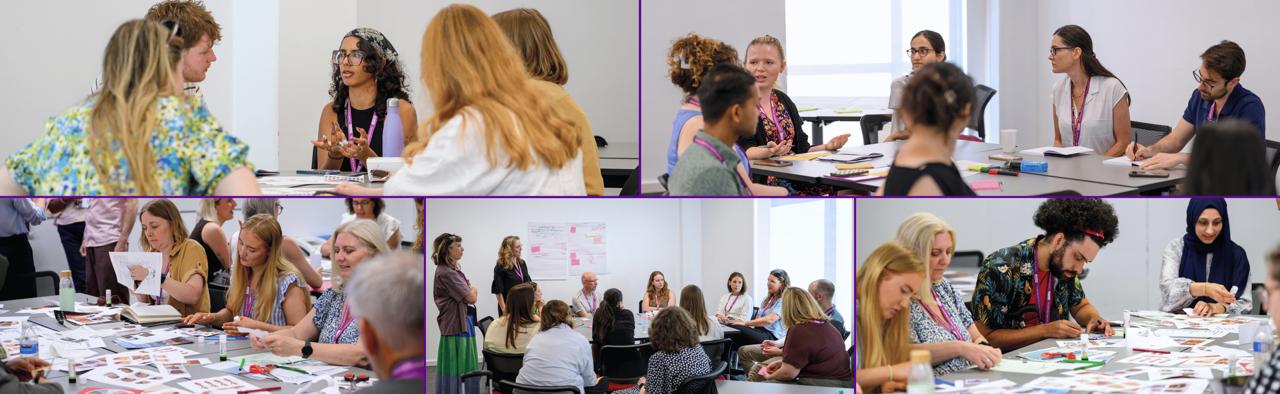
From Fear to Fairness: Co-creating Inclusive Fitness to Practise Cultures
Pat Cartney and Polly Turner
Building a Community of Practice for Neurodivergent Teaching and Learning Scholarship
Janine Dixon and Amber Ruigrok
Bringing Student-led Innovation in Teaching and Learning Practice: Scaling Models of Partnership Wit
Samhita Mukherjee and Fariha Agha
Supporting GTAs as Future Academics: An Action Learning Set on Expectations, Workload &Fair Practice
Alison Zimmer, Anowyesha Dash, Hien Dao, Jieyichi Zhao, Alkiviadis Fioratos, Ernestina Zhu, Eve Suharwardy, Samia Marium and Tessa Harris
Making Advising Work for All: Exploring Boundaries and Inclusion for Neurodivergent Students
Janine Dixon and Neil Morrison
From Learning Outcomes to Competence: What Should Graduates Be Able to Do
Tayyib Majumder, Nadia Choy, Iman M. Afif, William Blair, Arham Adil, Ruoxi Wang and DR Salman Shahid
Embedding AI in the Curriculum: Are We Developing Skills or Following the Hype?
Tatiana Matinez, Zhiteng Feng, Sally Gee and Na Zuo
What Does Belonging Mean to You? A Reframing Workshop.
Elora Baishnab, Heather Cockayne, Adam Danquah, Sadia Habib, Katie Newton, Manny Oladipo, Alisha Rahman and Christopher Sutton
Engaging in Meaningful Scholarship
Rachel Ashworth, Alison Fisher, Wai Yeung, Hannah Taylor, Ruth Johnson, Doron Cohen and Annie Pye
Talking with Strangers
Verity Langlands, Rachel Starkey, Helen Chilton, Esnath Magola-Makina, Claire Burns, Rachel Lindley, Emmanuel Oladipo, Belen Lopez-Perez, Saneya Majotra, Annette Okeke and Justin Ward
Educators, Assessment and Academic Integrity
Elika Aminian, James Brooks, Jilian Yeow and Skye Zhao
Animating the Soul of Learning
Mark Johnson and Siobhan Cartwright
Academic Advising – All Change?
Annette Nordhausen Scholes
Wicked Problem Sets
2026
Poster Presentations
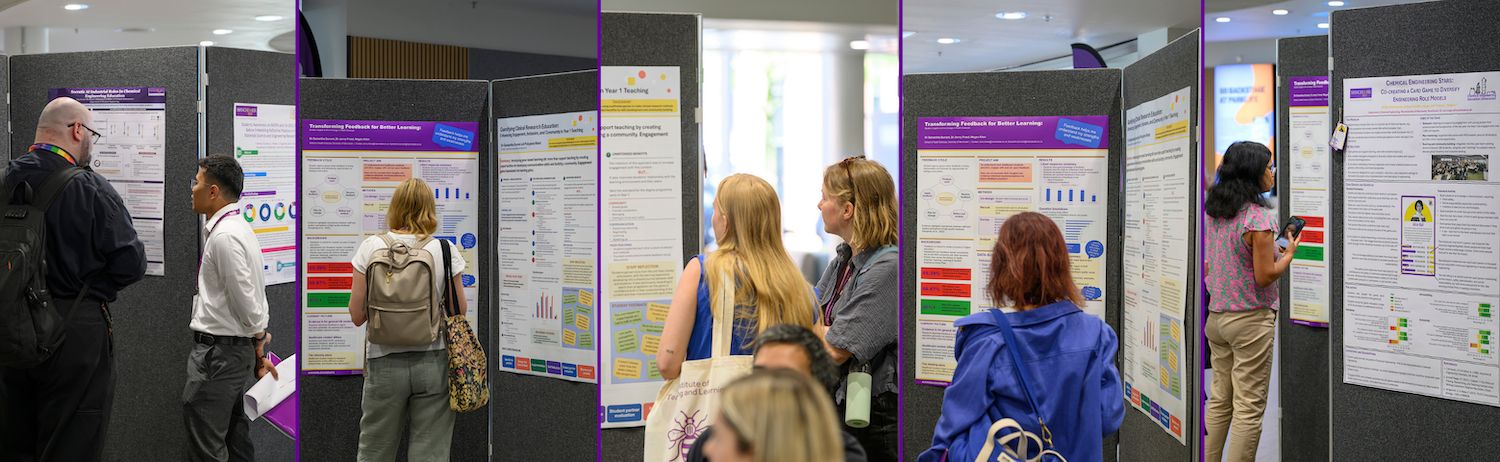
The conference featured a series of engaging Poster Presentations that explored innovative approaches to Teaching and Learning across a range of disciplines. Highlights included Artificial Intelligence in Higher Education, student engagement and co-creation, inclusive curriculum design, assessment and feedback, sustainability initiatives, and subject-specific educational approaches. Together, these presentations fostered knowledge sharing, encouraged attendees to reflect on existing practices, and inspired further exploration of approaches to enhancing Teaching and Learning.
You can also find the album of poster presentations here.
Lightning Talks
The Lightning Talks sessions featured dynamic and insightful presentations from staff and students, delivering concise insights into current developments, challenges and emerging approaches in Teaching and Learning through a fast-paced format. Talks explored a range of themes, including Innovation in Assessment, Using (and not abusing) AI in Assessment and Beyond, Research Informed and Innovative Teaching, Accessibility and Inclusion in Assessment, the Digital and Beyond, Playful Experiences and Gamified Learning, and Communication and Clarity in Teaching and Learning. The format enabled presenters to share ideas in a focused and accessible way, followed by interactive Q&A discussions that encouraged rich dialogue, critical reflection and knowledge exchange among attendees. Together, the sessions showcased diverse perspectives and practical approaches that contributed to ongoing conversations about improving teaching and learning.
Watch this year's Lightning Talks:
- Playful, experiential and gamified learning (D1.1.4)
- Communication and Clarity in Teaching and Learning (D1.3.4)
- Innovation in Assessment (D2.1.4)
- Using (and not abusing) AI in Assessment and Beyond (D2.2.4)
- Research Informed and Innovative Teaching (D2.3.4)
- Accessibility and Inclusion in Assessment, the Digital and Beyond (D2.4.4)