


EC Horizon Europe 2021-2027
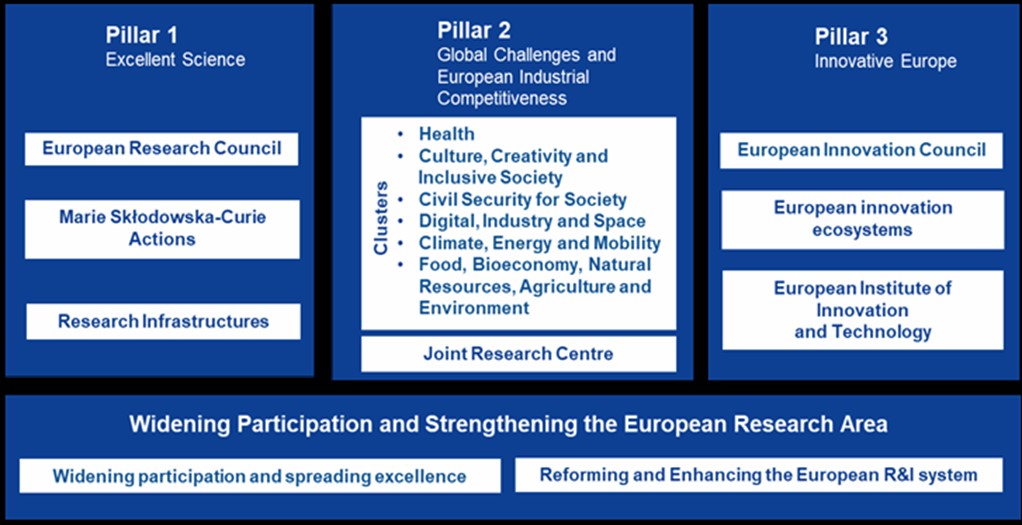
The entire Horizon Europe programme amounts to about €95.5 billion, of which €5 billion are from the EU’s COVID stimulus fund, the Next Generation EU. In total, this represents a 30% increase over the previous research and innovation programme, Horizon 2020, and makes Horizon Europe the most ambitious research and innovation programme in the world. Over 35% of Horizon Europe will contribute to climate objectives.
The UK has officially rejoined the EU’s research and innovation funding programme Horizon Europe, ending three years of stand by and provisional procedures for participation and award.
As of 1 January 2024, researchers can apply to the vast majority of the research programme calls, and are able to lead consortia. The government struck a deal with the EU for the country’s access to the scheme in September, and it started paying for its membership to Horizon Europe as the new year started.
The Horizon Europe Regulation and the Specific Programme was published in the Official Journal of the EU with a long delay, on 12 May 2021 when it became law. The Regulation was applied retroactively from 1 January 2021, thus covering the early Horizon Europe calls launched before May.
Major research funding opportunity – EU Horizon scheme
27 Oct 2023 University of Manchester announcement
Researchers are encouraged to get ready to participate in Horizon schemes and funding calls
You may recall the welcome news that the UK government and the European Commission had reached an agreement, and the UK would join the EU’s £85 billion science research programmes, Horizon Europe and Copernicus programmes.
Professor Colette Fagan, Vice-President for Research, says: “I am delighted that Association to Horizon Europe has been agreed. This agreement opens up significant research funding and collaboration opportunities. The University has a great track record of success under previous calls to build upon.
“Liz Fay, our EU Funding and Development Manager and our Faculty research services team have the expertise to support the development of your application. I encourage all researchers to find out more about the opportunities for advancing their own research and to consider making an application.”
The UK will officially associate to Horizon Europe as of 1 January 2024 once the relevant protocol is signed. UK organisations and researchers are able to apply for the vast majority of Horizon calls, and UK researchers will be able to lead consortia in the next round of Horizon Europe projects.
This agreement will be a significant boost for the University’s world-leading research and researchers and will give UK companies and research institutions unrivalled opportunities to lead global work to develop new technologies and research projects, in areas from health to AI.
The University has had exceptional success in Horizon Europe throughout the transition phase via the UK government’s guarantee funding scheme. We have had 93 funded projects, 18 European Research Council, 12 Marie Skłodowska-Curie Actions (MSCA) Individual Fellowships, 10 MSCA Doctoral Networks, MSCA Staff Exchanges and funding to maintain dozens of networks.
Researchers are encouraged to build on this track record and to apply to the different Horizon schemes and funding calls that are available. Staff within the Directorate of Research and Business Engagement are available to support researchers with bid applications for 2023 and 2024.
For information on the different deadlines and schemes currently available, please visit:
Note that the UK government chose not to associate to Euratom Research and Training Programme, and instead will put in place a suite of alternative Research and Development programmes to support the UK’s flourishing fusion sector and strengthen international collaboration in support of the UK Fusion Strategy. The government plans to invest up to £650 million until 2027, subject to business case approvals. Further details will be announced in due course.
The Department for Energy Security and Net Zero has advised us that researchers should continue to plan for involvement in Euratom calls, as many will be covered by a similar funding guarantee to that which covered the transition phase for Horizon Europe.
For clarification on applying for Euratom calls, please visit:
For further information, contact Liz Fay, EU Funding and Development Manager via email at:
Horizon Europe Research framework structure
Preliminary structure
Pillar 1 (€25.8b): Excellence Science:
- ERC (€16.6b)
- MSCA (€6.8b)
- Research Infrastructures (€2.4b)
Pillar 2 (€52.7b): Global Challenges and European Industrial Competitiveness (GCEIC) (includes what are currently H2020 SCs):
- Health
- Culture, Creativity and Inclusive Society
- Civil Security for Society
- Digital, Industry and Space
- Climate, Energy and Mobility
- Food, Bioeconomy, Natural Resources, Agriculture and Environment
- Joint Research Centre
Pillar 3 (€13.5b):
- European Innovation Council (EIC)
- European innovation ecosystems
- European Institute of Innovation and Technology
Widening Participation and Strengthening the European Research Area (€2.1b):
- Widening participation and spreading excellence
- Reforming and Enhancing the European R&I system
Work Programme 2023-2024 - For reference only
The European Commission adopted the main Horizon Europe Work Programme for 2023 and 2024 on 6 December 2022 and published the final versions of the individual Work Programme parts in the 'Reference documents' section of the Funding & Tenders Portal. Some of the first 2023 calls for proposals, worth more than €13 billion in total, have already been launched.
There are dedicated Work Programmes for each part of the Horizon Europe Pillars, including the six Clusters and the Horizon Europe Missions. Separate 2023 Work Programmes are available for the European Research Council (ERC) and the European Innovation Council (EIC) which includes funding opportunities worth €1.6 billion.
This completes the adoption process for the 2023 Work Programme of Horizon Europe.
What will be funded under the second biannual Work Programme?
R&I investments planned under the 2023-24 Work Programme will contribute to the EU reaching its climate goals, increasing energy resilience, and developing core digital technologies. They will also address targeted actions to support Ukraine, boost economic resilience and contribute to a sustainable recovery from the COVID-19 pandemic:
- €5.67 billion is dedicated to reaching key climate action objectives, finding innovative solutions to reduce greenhouse gas emissions and adapting to climate change. €1.67 billion contributes to supporting biodiversity.
- Over €4.5 billion will support the EU digital transition, including the development of core digital technologies and encouraging their integration in our lives.
- New actions to support Ukraine include reinforcing the access of researchers from this country to European research infrastructures, continuing support to the health scientists from Ukraine, and supporting the climate-neutral reconstruction of several Ukrainian cities through the EU Mission for Climate-Neutral and Smart Cities.
- In 2023, the main Work Programme will direct investments of more than €1 billion from NextGeneration EU towards Europe's recovery from the economic and social damage caused by the COVID-19 pandemic.
- Nearly €970 million will be invested to help speed up the clean energy transition, in line with the REPowerEU Plan, and increase Europe's energy independence from unreliable suppliers and volatile fossil fuels.
- In line with the Strategy for International Cooperation in Research & Innovation that underpins the international dimension of Horizon Europe, the calls for collaborative projects will be characterised by general openness and international cooperation with non-EU partners will be strongly encouraged. In particular, the Commission will continue with the ‘Africa Initiative’, while also introducing the new ‘Mediterranean Initiative', responding to the new R&I agenda developed with the Union for the Mediterranean.
What is new in the second Horizon Europe Work Programme?
Below is a non-exhaustive list of the main changes from the 2021-22 Work Programme, which are included in the General Annexes.
- The General Annexes now explicitly state that to participate as a beneficiary, legal entities must be eligible for EU funding. While this has been the case right from the beginning of Horizon Europe, as previously reported by UKRO, the Work Programme 2021-22 never explicitly mentioned this rule.
- Participation of Chinese organisations in Innovation Actions (IA) - Under Article 22(6) of the Horizon Europe Regulation, legal entities established in China will no longer be eligible to participate in Horizon Europe Innovation Actions in any capacity. This includes participation as beneficiaries, affiliated entities, associated partners, third parties providing in-kind contributions, subcontractors or recipients of financial support to third parties, although, exceptions may be granted on a case-by-case basis for well-justified reasons. This new restriction on participation may be reviewed in the future in accordance with policy developments.
- Participation of Russian and Belarusian organisations in Horizon Europe projects – the current restrictions on the participation of organisations from both countries, as well as those based in non-government-controlled territories of Ukraine, remain in place. However, the General Annexes now clarify that such legal entities are not eligible to participate in any capacity even when they are not subject to specific EU restrictive measures.
- Lump sums – Detailed information is included in the General Annexes about the different page limits for applications submitted to lump sum calls, as well as lump sum-specific evaluation modalities. This information is consistent with the recently published Commission guidance on applying to lump sum calls. Subscribers are reminded that the 2023-24 Work Programme will include a significantly higher share of topics that use the lump sum approach when compared to the first biannual Work Programme, as reported by UKRO previously.
Where can I find more information about the Work Programme?
Commission information days
The Commission is already holding a series of information days on the 2023 calls for proposals included in the new Work Programme. These events give prospective applicants and other stakeholders the opportunity to get information about the upcoming calls and ask questions about the main funding instruments and processes of Horizon Europe.
The already confirmed information days can be found on the Commission's dedicated website. In addition to this, the European Innovation Council will hold a dedicated information day on its 2023 calls next week.
UKRO factsheets
Following the publication of the 2023-24 Work Programme, UKRO is in the process of updating its factsheets on the individual Horizon Europe programme parts.
The UK position regarding Horizon Europe is that researchers should continue to apply, we don’t know yet if the government guarantee will be extended to cover successful projects with call deadlines after the end of December 2022 but the government has said that no successfully evaluated project will go unfunded. The UK still hopes to associate to Horizon Europe.
Liz Fay | EU Funding and Development Manager | The University of Manchester | Crawford House | Oxford Road |Manchester M13 9PL | Liz.Fay@manchester.ac.uk | European Commission – Funding and Tender Opportunities Portal
Horizon Europe Guarantee funding for awards from Horizon Europe - For reference only
This information is relevant only for those projects awarded before the UK association to the Horizon Europe framework.
The UK Government announced in November 2021 a new financial safety net mechanism that aims to provide certainty for successful Horizon Europe applicants, as the association delays continue: The Guarantee funding scheme. Under this mechanism, successful UK applicants for Horizon Europe grant awards were guaranteed funding regardless of the outcome of the UK’s efforts to associate to Horizon Europe.
For further details, please visit: https://www.gov.uk/government/publications/horizon-europe-guarantee-open-letter-to-the-uk-research-and-development-sector
For further specific advice individuals should contact the University research support staff and the university EU Funding and Development Manager.
- Liz Fay | EU Funding and Development Manager | Mansfield Cooper Building – Room 2.16 | Oxford Road |Manchester M13 9PL | Tel: + 44 161 275 7114 | Liz.Fay@manchester.ac.uk
UK Associated Country to Horizon Europe
Horizon Europe and UK participation
The UK’s association to Horizon Europe and Copernicus was officially sealed on 4 December. The association agreement was adopted in the form of a protocol to the Trade and Cooperation Agreement by the EU-UK Specialised Committee on Participation in Union Programmes.
After the announcement on 7 September 2023, UK organisations are able to participate in Horizon Europe calls for proposals on the same terms as institutions from other Associated Countries, including leading consortia and receiving EU funding, from the 2024 Work Programme and onwards. This includes any 2024 calls opening this year.
The UK Government has published a helpful explainer document, which includes clarifications on many issues related to the UK association to both programmes.
(Liz Fay | EU Funding and Development Manager | The University of Manchester | M45 Crawford House | Oxford Road |Manchester M13 9PL - Liz.Fay@manchester.ac.uk)
The European Commission adopted the main Horizon Europe Work Programme for 2023 and 2024 on 6 December 2022 and published the final versions of the individual Work Programme parts in the 'Reference documents' section of the Funding & Tenders Portal.
There are dedicated Work Programmes for each part of the Horizon Europe Pillars, including the six Clusters and the Horizon Europe Missions. Separate Work Programmes are available for the European Research Council (ERC) and the European Innovation Council (EIC) which includes funding opportunities worth €1.6 billion.
Next steps
Department for Science, Innovation and Technology will shortly launch a communications campaign to maximise participation in Horizon Europe and Copernicus from researchers, academics and businesses of all sizes in the UK. This PR push will shine a light on the real-world examples of the benefits Horizon and Copernicus participation can deliver for academics, researchers and businesses, right across the UK – particularly small and medium-sized businesses involved in R&D, which might not have previously considered applying.
Alongside this, in a partnership with the British Academy and other key backers, support will be made available to selected UK researchers applying for Horizon for the first time, through ‘pump priming’ funding, with up to £10,000 available per application. The funding will be available to support those researchers who have not previously had experience, including next generation researchers. The fund will be targeted to ensure it maximises the UK’s involvement in Horizon.
Basic sources of information about the Work Programme
- Commission information days. The Commission is already holding a series of information days on the 2023 calls for proposals included in the new Work Programme. These events give prospective applicants and other stakeholders the opportunity to get information about the upcoming calls and ask questions about the main funding instruments and processes of Horizon Europe. Confirmed information days can be found on the Commission's dedicated website.
- UKRO factsheets</a on the individual Horizon Europe programme parts are available online.
- European Commission – Funding and Tender Opportunities Portal
For calls under the Horizon Europe Work Programme 2024, successful UK applicants will be funded as beneficiaries by the EC, belonging to an Associated country to the EU.
The UK benefits from all the main Horizon Europe pillars and schemes as previous Brexit, the UK contributes to the HEU budget, there are not divergences as beneficiaries of a grant, and procedures are the same than other European participants for most schemes, with exceptions.
Improvements for accessibility, submissions, and processes on ERC, MSCA and Clusters, and other schemes, and collaboration with other European institutions.
Submissions as per beneficiary rules coordination or participation, with restrictions only to eligibility to some specific schemes for EU members only.
Relevant documentation and links:
- DSIT has published a helpful explainer document
- UK Government explainer document on UK Association to Horizon Europe and Copernicus Joint statement by the UK and Commission
- UK Gov press release
- EC Q&A on the UK’s association to Horizon Europe and Copernicus
- EU Funding Website
- European Commission – Funding and Tender Opportunities Portal
- Liz Fay | EU Funding and Development Manager | Mansfield Cooper Building – Room 2.16 | Oxford Road |Manchester M13 9PL | Tel: + 44 161 275 7114 | Liz.Fay@manchester.ac.uk
Culture, Creativity and Inclusive Society (Cluster 2) WP 2027 (draft)
The work programme is available online but this is only a draft made available by the EC to support applicants with their consortia preparation in advance of the official publication later in the year. Deadline for submissions for all the topics is 16 September 2027.
The Commission will award budgets in the form of the new lump sum, except for a COFUND requirement for a transformation partnership topic. The amounts after each topic are the suggested maximum from the Commission.
What is funded? The type of actions will influence the type of partnership, activities and budget requirements:
- RIA = Research and Innovation actions
- IA = Innovation Actions
- CSA = Coordination & Support Actions
Topics:
*Destination Innovative Research on Democracy and Governance).
- HORIZON-CL2-2027-01-DEMOCRACY-01: Advisory support and network for countering and preventing radicalisation, extremism, hate speech and polarisation. CSA. Total funding €3.5m. Average project budget €3 to €3.5m. 1 award.
- HORIZON-CL2-2027-01-DEMOCRACY-02: Women’s, LGBTIQ and minority rights in a context of autocracy, conflict and geopolitical shifts. RIA. Total funding €12m. Average project budget €3.5 to €4m. 3 awards.
- HORIZON-CL2-2027-01-DEMOCRACY-03: Student and family engagement for developing a culture of democratic/civic participation. RIA. Total funding €12m. Average project budget €3.5 to €4m. 3 awards.
- HORIZON-CL2-2027-01-DEMOCRACY-04: Addressing the impact of artificial intelligence, cyberviolence, and deepfakes on equality, democracy and inclusive societies. RIA. Total funding €20m. Average project budget €3.5 to €4m. 5 awards.
- HORIZON-CL2-2027-01-DEMOCRACY-05: Development aid and democratic governance. RIA. Total funding €12m. Average project budget €3.5 to €4m. 3 awards.
- HORIZON-CL2-2027-01-DEMOCRACY-06: Identifying user-focused solutions to support news media freedom. RIA. Total funding €12m. Average project budget €3.5 to €4m. 3 awards.
- HORIZON-CL2-2027-01-DEMOCRACY-07: The role of private companies in democracy. RIA. Total funding €8m. Average project budget €3.5 to €4m. 2 awards.
- HORIZON-CL2-2027-01-DEMOCRACY-08: Global Human Rights and EU values. RIA. Total funding €12m. Average project budget €3.5 to €4m. 3 awards.
*Destination Innovative Research on European Cultural Heritage and Cultural and Creative Industries
- HORIZON-CL2-2027-01-HERITAGE-01: Towards a consolidated culture and creativity driven European innovation ecosystem. CSA. Total funding €5m. Average project budget €5m. 1 award.
- HORIZON-CL2-2027-01-HERITAGE-02: AI4Creatives Support Platform: embracing a fair AI revolution. CSA. Total funding €5m. Average project budget €4.5 to €5m. 1 award.
- HORIZON-CL2-2027-01-HERITAGE-03: Crafting routes to a circular economy. RIA. Total funding €10.5m. Average project budget €3 to €3.5m. 3 awards.
- HORIZON-CL2-2027-01-HERITAGE-04: Culture, heritage and creative industries for health and well-being. RIA. Total funding €16m. Average project budget €3 to €4m. 4 awards.
- HORIZON-CL2-2027-01-HERITAGE-05: Re-imagining the creative economy: the interplay between the cultural and creative sectors and industries and the social economy. RIA. Total funding €10.5m. Average project budget €3 to €3.5m. 3 awards.
- HORIZON-CL2-2027-01-HERITAGE-06: Future-proofing sustainable cultural tourism. RIA. Total funding €14.5m. Average project budget €4 to €4.8m. 3 awards.
- HORIZON-CL2-2027-01-HERITAGE-07: Societal impact of cultural heritage. RIA. Total funding €15m. Average project budget €2.5 to €3m. 5 awards.
- HORIZON-CL2-2027-01-HERITAGE-08: Safeguarding & transmission of intangible cultural heritage. RIA. Total funding €12m. Average project budget €3 to €4m. 3 awards.
*Destination Innovative Research on Social and Economic Transformations
- HORIZON-CL2-2027-01-TRANSFO-01: How does access to nature-positive environments promote social cohesion and reduce inequalities in urban and peri-urban settings? RIA. Total funding €12m. Average project budget €3 to €4m. 3 awards.
- HORIZON-CL2-2027-01-TRANSFO-02: Impact of in-kind benefits on income distribution and on vulnerable populations. RIA. Total funding €10m. Average project budget €3 to €3.3m. 3 awards.
- HORIZON-CL2-2027-01-TRANSFO-03: Rethinking sustainable competitiveness beyond traditional perspectives: role and contribution of the Social Economy. RIA. Total funding €12m. Average project budget €3 to €4m. 3 awards.
- HORIZON-CL2-2027-01-TRANSFO-04: The impact of EU labour mobility on the Member States of the EU. RIA. Total funding €12m. Average project budget €3 to €4m. 3 awards.
- HORIZON-CL2-2027-01-TRANSFO-05: The effective use of artificial intelligence in learning environments in pre-primary and primary education. RIA. Total funding €12m. Average project budget €3 to €4m. 3 awards.
- HORIZON-CL2-2027-01-TRANSFO-06: Closing the learning gap: uncovering causes and effective policy interventions for declining youth skills in mathematics, reading, and science. RIA. Total funding €12m. Average project budget €3 to €4m. 3 awards.
- HORIZON-CL2-2027-01-TRANSFO-07: Persons with disabilities: opportunities for labour inclusion and social protection through the life course. RIA. Total funding €12m. Average project budget €3 to €4m. 3 awards.
- HORIZON-CL2-2027-01-TRANSFO-08: Scaling and deploying innovations in migration management. IA. Total funding €15m. Average project budget €3 to €3.75m. 4 awards.
Culture, Creativity and Inclusive Society (Cluster 2) WP 2026 (draft)
The work programme is available online but this is only a draft made available by the EC to support applicants with their consortia preparation in advance of the official publication later in the year. Deadline for submissions for all the topics is 16 September 2026.
The Commission will award budgets in the form of the new lump sum, except for a COFUND requirement for a transformation partnership topic. The amounts after each topic are the suggested maximum from the Commission.
What is funded? The type of actions will influence the type of partnership, activities and budget requirements:
- RIA = Research and Innovation actions
- IA = Innovation Actions
- CSA = Coordination & Support Actions
Topics:
*Destination Innovative Research on Democracy and Governance
- HORIZON-CL2-2026-01-DEMOCRACY-01: Tackling gender-based violence against politically active women and LGBTIQ people. RIA. Total funding €12m. Average project budget €3.50 to €4m. 3 awards.
- HORIZON-CL2-2026-01-DEMOCRACY-02: Understanding the forms of local democracy in low-income and low-middle income countries. RIA. Total funding €12m. Average project budget €3.50 to €4m. 3 awards.
- HORIZON-CL2-2026-01-DEMOCRACY-03: Government in transition – how governments change the way they work and prepare the civil service for the future. RIA. Total funding €8m. Average project budget €3.50 to €4m. 3 awards.
- HORIZON-CL2-2026-01-DEMOCRACY-04: Sustainable paths to media viability. IA. Total funding €12m. Average project budget €3.50 to €4m. 3 awards.
- HORIZON-CL2-2026-01-DEMOCRACY-05: Research and Innovation Network for a Union of Equality. CSA. Total funding €4.5m. Average project budget €4 to €4.5m. 1 award.
- HORIZON-CL2-2026-01-DEMOCRACY-06: Governing global commons sustainably. RIA. Total funding €12m. Average project budget €3.50 to €4m. 3 awards.
- HORIZON-CL2-2026-01-DEMOCRACY-07: Supporting post-conflict democracy and reconstruction. RIA. Total funding €12m. Average project budget €3.50 to €4m. 3 awards.
- HORIZON-CL2-2026-01-DEMOCRACY-08: Electoral integrity in the digital context. RIA. Total funding €12m. Average project budget €3.50 to €4m. 3 awards.
- HORIZON-CL2-2026-01-DEMOCRACY-09: Lifelong learning of citizenship education and citizen participation. RIA. Total funding €16m. Average project budget €3.50 to €4m. 4 awards.
- HORIZON-CL2-2026-01-DEMOCRACY-10: Digital and media literacy as drivers for democratic and civic resilience. RIA. Total funding €12m. Average project budget €3.50 to €4m. 3 awards.
*Destination Innovative Research on European Cultural Heritage and Cultural and Creative Industries.
- HORIZON-CL2-2026-01-HERITAGE-01: “Artistic intelligence”: harnessing the power of the arts to address complex challenges, enhance soft skills and boost innovation and competitiveness. RIA. Total funding €15m. Average project budget €4.50 to €5m. 3 awards.
- HORIZON-CL2-2026-01-HERITAGE-02: Boosting creative startups for disruptive innovation. IA. Total funding €12m. Average project budget €5 to €6m. 2 awards.
- HORIZON-CL2-2026-01-HERITAGE-03: AI integration in CCSI work practice: catalysing innovation and competitiveness. IA. Total funding €15m. Average project budget €4 to €5m. 3 awards.
- HORIZON-CL2-2026-01-HERITAGE-04: Towards a fair and transparent market for cultural and creative content in the era of generative AI. RIA. Total funding €12m. Average project budget €3 to €4m. 3 awards.
- HORIZON-CL2-2026-01-HERITAGE-05: Creative alliances: Fostering global partnerships in cultural policies and CCI innovation. RIA. Total funding €15m. Average project budget €3 to €3.75m. 4 awards.
- HORIZON-CL2-2026-01-HERITAGE-06: Safeguarding linguistic diversity in Europe. RIA. Total funding €11.5m. Average project budget €5 to €5.75m. 2 awards.
- HORIZON-CL2-2026-01-HERITAGE-07: Preventing and fighting illicit trafficking of cultural goods. CSA. Total funding €5m. Average project budget €4.50 to €5m. 1 award.
*Destination Innovative Research on Social and Economic Transformations.
- HORIZON-CL2-2026-02-TRANSFO-01: Co-funded European Partnership for Social Transformations and Resilience. COFUND. €60m for one award only.
- HORIZON-CL2-2026-01-TRANSFO-02: Open topic: Strengthen Europe's social model and sustainable competitiveness through productivity. RIA. Total funding €12m. Average project budget €3 to €4m. 3 awards.
- HORIZON-CL2-2026-01-TRANSFO-03: Tackling child poverty and ensuring disadvantaged children's access to Early Childhood Education and Care. RIA. Total funding €12m. Average project budget €3 to €4m. 3 awards.
- HORIZON-CL2-2026-01-TRANSFO-04: The impact of the use of digital tools outside school and for communication on educational outcomes and mental health. RIA. Total funding €12m. Average project budget €3 to €4m. 3 awards.
- HORIZON-CL2-2026-01-TRANSFO-05: Long-term contribution of basic skills to productivity, innovation, competitiveness and economic growth. RIA. Total funding €12m. Average project budget €3 to €4m. 3 awards.
- HORIZON-CL2-2026-01-TRANSFO-06: Making Europe a global magnet for talent - Attracting and retaining students, researchers and high-skilled workers from outside the EU. RIA. Total funding €10m. Average project budget €3 to €3.3m. 3 awards.
- HORIZON-CL2-2026-01-TRANSFO-07: Fostering competences for the green transition. RIA. Total funding €12m. Average project budget €3 to €4m. 3 awards.
- HORIZON-CL2-2026-01-TRANSFO-08: Strengthened implementation of the EU Pact on Migration and Asylum and a focus on inclusion, integration, and health. RIA. Total funding €12m. Average project budget €3 to €4m. 3 awards.
- HORIZON-CL2-2026-01-TRANSFO-09: Rethinking long-term care policy in the face of EU demographic shifts. RIA. Total funding €15m. Average project budget €3.50m. 4 awards.
- HORIZON-CL2-2026-01-TRANSFO-10: Fostering cooperation and integration between SSH and STEM research and innovation in the EU. CSA. Total funding €3.5m. Average project budget €3.50m. 1 award.
Culture, Creativity and Inclusive Society (Cluster 2) WP 2025
The work programme is available online (reference documents, Work Programme 2025), deadline for submission to all the topics is 16 September 2025.
The Commission will award budgets in the form of the new lump sum, except for a co-financing requirement for a heritage partnership topic included below with a list of all the topics available. The amounts after each topic are the suggested maximum from the Commission.
What is funded? The type of actions will influence the type of partnership, activities and budget requirements:
- RIA = Research and Innovation actions
- IA = Innovation Actions
- CSA = Coordination & Support Actions
Topics:
- HORIZON-CL2-2025-01-DEMOCRACY-01: Advisory support and network to counter disinformation and foreign information manipulation and interference (FIMI). CSA. €3.5m.
- HORIZON-CL2-2025-01-DEMOCRACY-02: Fostering the consolidation of European science diplomacy. CSA. €3m.
- HORIZON-CL2-2025-01-DEMOCRACY-03: Preparing the EU for future enlargement: challenges and opportunities. RIA. €3.5m.
- HORIZON-CL2-2025-01-DEMOCRACY-04: Open strategic autonomy, economic and research security in EU foreign policy. RIA. €3.5m.
- HORIZON-CL2-2025-01-DEMOCRACY-05: Countering and preventing radicalisation, extremism, hate speech and polarisation. RIA. €3.5m.
- HORIZON-CL2-2025-01-DEMOCRACY-06: Towards a European research hub on contemporary antisemitism and Jewish life and culture. CSA. €3.5m.
- HORIZON-CL2-2025-01-DEMOCRACY-07: The autocratic appeal: nature, drivers and strategies. RIA. €3.5m.
- HORIZON-CL2-2025-01-DEMOCRACY-08: Economic inequalities and their impact on democracy. RIA. €3.5m.
- HORIZON-CL2-2025-01-DEMOCRACY-09: Fighting against disinformation while ensuring the right to freedom of expression. RIA. €3.5m.
- HORIZON-CL2-2025-01-DEMOCRACY-10: The role of civic and citizenship education for strengthening civic and democratic participation and support for common European values. RIA. €3.5m.
- HORIZON-CL2-2025-01-DEMOCRACY-11: Independence of the judiciary as an aspect of rule of law compliance. RIA. €3.5m.
- HORIZON-CL2-2025-01-DEMOCRACY-12: Community of democracy practitioners and researchers. CSA. €3.5m.
- HORIZON-CL2-2025-03-HERITAGE-01: Co-funded European partnership for Resilient Cultural Heritage. Co-fund. €60m.
- HORIZON-CL2-2025-02-HERITAGE-02-two-stage: Innovative approaches to intangible cultural heritage for societal resilience. RIA. €3m to €4m.
- HORIZON-CL2-2025-01-HERITAGE-03: A European Collaborative Cloud for Cultural Heritage – Innovative use cases. IA. €2.5m to €4m.
- HORIZON-CL2-2025-01-HERITAGE-04: Leveraging artificial intelligence for creativity- driven innovation. RIA. €4m to €5m.
- HORIZON-CL2-2025-01-HERITAGE-05: Evolution of culture in a virtualising world. RIA. €2.5m to €3.5m.
- HORIZON-CL2-2025-01-HERITAGE-06: Europe as a global powerhouse of design for sustainable competitiveness. RIA. €3.5m to €4.5m.
- HORIZON-CL2-2025-01-HERITAGE-07: Cultural Strategies for Peace: culture and creativity as catalysts for conflict prevention and post-conflict reconciliation. RIA. €3m to €4m.
- HORIZON-CL2-2025-01-HERITAGE-08: Bridging historical past and future potential through conservation, preservation, and adaptive use of Europe’s contentious and dissonant heritage. CSA. €2.5m to €3.5m.
- HORIZON-CL2-2025-01-HERITAGE-09: Impacts of culture and the arts on health and well-being. CSA. €2m.
- HORIZON-CL2-2025-01-TRANSFO-01: Tackling gender-based violence in different social and economic spheres. RIA. €3.4m.
- HORIZON-CL2-2025-01-TRANSFO-02: Historical and regional analyses of industrial transitions and their lessons for ensuring a fair green transition. RIA. €3.4m.
- HORIZON-CL2-2025-01-TRANSFO-03: Working time reduction: barriers, challenges, benefits and policy implications. RIA. €3.4m.
- HORIZON-CL2-2025-02-TRANSFO-04-two-stage: Gender differences in career trajectories of parents and their implications for gender equality and family well-being. RIA. €3.4m.
- HORIZON-CL2-2025-01-TRANSFO-05: Improving fairness in the economy through a better understanding of undeclared and underdeclared work. RIA. €3.4m.
- HORIZON-CL2-2025-01-TRANSFO-06: Evaluation and use of evidence in education policy and practice. RIA. €3.4m.
- HORIZON-CL2-2025-01-TRANSFO-07: Impact of the learning environment and the use of digital tools in everyday life on key skills and competence development. RIA. €3.4m.
- HORIZON-CL2-2025-01-TRANSFO-08: Improving mental health outcomes for people in education, training and work. RIA. €3m to €5m.
- HORIZON-CL2-2025-01-TRANSFO-09: Good practices for increased autonomy of persons with disabilities, including physical, mental, intellectual and sensory disabilities. RIA. €3.4m.
- HORIZON-CL2-2025-01-TRANSFO-10: Intergenerational fairness in the context of demographic change in the EU. RIA. €3m to €4m.
- HORIZON-CL2-2025-01-TRANSFO-11: Migration and climate change: building resilience and enhancing sustainability. CSA. €2m.
Consortia building - call information
The schemes outlined below could be excellent source for the preparation and building of partnerships for Consortia and submissions to Pillar 2 of Horizon Europe. The timeline for submissions to 2026 and 2027 should allow for submission to these pre-proposal/networking calls in the first plate to evaluate the feasibility and the strength of partnerships.
Flexible award which funds curiosity-driven research, networking activity and idea generation, which enables the development of further research opportunities and new research agendas.
These awards will support teams, networks and solo researchers. Up to 60 months and £100k, fEC.
This scheme is open for submissions any time since end January 2025.
COST Actions invite researchers to set up networking projects – and get a foot in the door at Horizon Europe. Researchers who get COST backing have a 37% success rate in applying for
Horizon Europe grants, significantly higher than the overall success rate of 15.9%.
COST Actions activities are flexible, fast, effective and efficient networking instruments requiring association of researchers from different institutions/organisations and countries allowing for
thematic discussions including of possible future large grants like those answering calls from EC coordination projects. Activities: Meetings, workshops, conferences, working groups,
committee meetings; Training schools; Short-term scientific missions (STSMs); Dissemination activities. Preparation for H2020, partnership building. At least 7 different COST full or cooperating
members including 3 from COST Inclusiveness Target Countries. Excellence and Inclusiveness. Direct costs. Annual deadlines. Next deadline 21/10/2025.
Inviting proposals from UK and EU/Associated Countries-based researchers to pump prime collaborations to support the effective uptake of the opportunities provided by the UK’s association to
Horizon Europe. The call is focused solely on Pillar 2 of Horizon Europe – Global Challenges and European Industrial Competitiveness.
Up to £10k, direct costs. Deadlines have been open for next Work Programme 2025, last opportunity passed 11/06/2025. More should be for the next work programme.
ERC- European Research Council 2025 deadlines
"To encourage the highest quality research in Europe through competitive funding and to support investigator-driven frontier research across all fields, on the basis of scientific excellence."
The ERC promotes bottom-up, curiosity-driven frontier research and offers the opportunity to boost the careers of excellent researchers from anywhere in the world.
Factsheets provided by UKRO are available on its website, UKRO is the National Contact Point for the UK. Deadlines of current and future calls are and will be included in the EC calls, Key calls, and the highlights pages.
Basically the ERC funds research grants to individuals, a sort of ‘fellowship, focusing on projects for an individual (hosted by an EU or associated country institution) of any nationality who could be at three different specific required levels of career development (early, consolidating, or professorial), who will receive a requested budget (from €1.5m to €2.5m plus additional optional allowances) including indirect costs for the host institution, to manage a project of her/his choice including the team(s) or her/his choice, in which she/he is the primary responsible and which will consolidate a career status. The main criteria: scientific excellence.
The ERC research programme runs in an annual basis, a reiterative programme with call deadlines in similar dates every year. The ERC Work Programme 2023 has been published and it is available online, the document includes some changes in relation to re-submissions, eligibility reference dates for Starting and Consolidator grants, synergy grants conditions, proof of concept grant evaluation elements, and some admisibility criteria.
ERC basic schemes and conditions
|
STG Starting Grants up to €1.5 Million for 5 years + up to €1 Million |
COG Consolidator Grants up to €2 Million for 5 years + up to €1 Million
|
ADG Advanced Grants up to €2.5 Million for 5 years + up to €1 Million
|
SYN Synergy Grants up to €10m for 6 years + up to €4 Million |
|
15/10/2024 |
14/01/2025 |
28/08/2025 |
06/11/2025 |
|
> 2 and ≤ 7 years prior to 1 January 2023. Cut-off dates: PhD awarded from 1 January 2016 to 31 December 2020 (inclusive)
|
> 7 and ≤ 12 years prior to 1 January 2023. Cut-off dates: PhD awarded from 1 January 2011 to 31 December 2015 (inclusive) |
10 years' track-record No specific criteria
|
early achievement track-record or a ten-year track-record outstanding intrinsic synergetic effect |
|
Proof of Concept Grants Lump sum €150k/18 months. Deadlines: 17/09/2024, 13/03/2025, 18/09/2025
|
|||
The maximum amount of the grants is reduced pro rata temporis depending on the project duration (except the Proof of Concept grants which awards lump sums).
Additional funding up to €1m (€4m for Synergy grants) can be requested to cover the following eligible costs when these are necessary to carry out the proposed work: "start-up" costs for PIs moving to the EU or an AC from elsewhere as a consequence of receiving the ERC grant and/or the purchase of major equipment and/or access to large facilities and/or other major experimental and field work costs, excluding personnel costs.
The ERC will expect total commitment from the project/awardee's host institution, complying with terms and conditions of the grants and allowing for an independent project providing institutional support to the project and awardee. Beneficiaries will receive 25% indirect costs from projects awarded.
All the ERC schemes are highly regarded by The University of Manchester.
ERC schemes
- ERC Starting Grant (SoG). Support for excellent Principal Investigators at the career stage at which they are starting their own independent research team or programme. Principal Investigators must demonstrate the ground-breaking nature, ambition and feasibility of their scientific proposal.
- ERC Consolidator Grant (CoG). Support for excellent Principal Investigators at the career stage at which they may still be consolidating their own independent research team or programme.
- Principal Investigators must demonstrate the ground-breaking nature, ambition and feasibility of their scientific proposal.
- ERC Advance Grant (AoG). Support for excellent Principal Investigators at the career stage at which they are already established research leaders with a recognised track record of research achievements. Principal Investigators must demonstrate the ground-breaking nature, ambition and feasibility of their scientific proposal.
- ERC Synergy Grant (SyG). A group of two to maximum four Principal Investigators (PIs); 'bottom-up' research without predetermined priorities. Applications must demonstrate that the proposed research cannot be carried out by a single PI working alone.
- ERC Proof of Concept Grant (PoC). All Principal Investigators in an ERC frontier research project are eligible to participate and apply for an ERC Proof of Concept Grant. The Principal Investigator must be able to demonstrate the relation between the idea to be taken to proof of concept and the ERC frontier research project (Starting, Consolidator, Advanced or Synergy) in question.
Links to relevant information
- ERC- European Research Council main page.
- Previous awards: available on the ERC website. Also can be provided by RSS when intention of submission is expressed.
- Events: proposal writing including individuals successful experiences are available during any year previous deadlines for submissions from UKRO (see below).
- Mission: what the basic principles of the ERC are.
- ERC newsletter: a good source of updated information. You can subscribe to email updates by submitting your email address at the bottom of the ERC newsletters page.
- Participant portal: past, present and forthcoming calls. Applicants can only apply from the call-portal. All the updated information is provided on the participant portal. Updates can be uploaded at any time.
- Support in the UK: the UK Research Office for H2020, UKRO, organising events together with the Commission to inform prospective applicants. UKRO is the National Contact Point for UK on ERC grants; any query on ERC grants can be addressed directly to the Office. UKRO provides online guidance documents; its factsheets are a good introduction to the schemes.
- Support from the Faculty of Humanities: Research Support Staff will address any request for information in the first place.
MSCA - Marie Skłodowska-Curie Actions Work Programme 2025
The portal reference documents (reference documents page>Work Programmes>2023-2025>HE Mani Work Programme 2023-2025>2. Marie Sklodowska-Curie Actions) website is updated with the official documents. The MSCA website it is other source of information for applicants.
UKRI encourages UK individuals to apply but please check with your RS team about suitability for submissions, the Horizon Europe pages including notes about and links to the UKRI Guarantee Funding.
UKRO and the MSCA website provide further support for prospective applicants.
Current deadlines:
- HORIZON-MSCA-2025-COFUND. Deadline: 24/06/2025.
- HORIZON-MSCA-2024/25-SE (Staff Exchanges). Deadline: 08/10/2025.
- HORIZON-MSCA-2025-PF (Postdoctoral Fellowships). Deadline: 10/09/2025.
- HORIZON-MSCA-2024/25-DN (Doctoral Networks). Deadline: 25/11/2025.
- HORIZON-MSCA-2025-INCO-01-01(International Cooperation). CSA. n/a.
- HORIZON-MSCA-2024-RR-01-01 (Researchers at Risk). Deadline 14/01/2025.
- HORIZON-MSCA-2025-CITIZENS-01-01 (Night). Deadline 22/10/2025.
Relevant links
- Horizon Europe dedicated website
- Portal reference documents
- Portal funding search
- #HorizonEU
- European Innovation Council
- EU budget for the future (MFF 2021-27)
- UKRO: UK Research Office Brussels and National Contact Point (NCP) for ERC and MSCA in the UK
- UoM support for HEU: Liz Fay | EU Funding and Development Manager | Mansfield Cooper Building – Room 2.16 | Oxford Road |Manchester M13 9PL | Tel: + 44 161 275 7114 | Liz.Fay@manchester.ac.uk
- UKRO links to HE factsheets (EC and UKRO's)
- UKRO links to drafts versions of work programmes for 2021 and 2022: Horizon News
- Innovate UK pages on Horizon Europe. Montly webinars Horizon Europe Hour Q&A sessions.
- new ERA or European Research Area
- Strategic Plan 2020-2024, Directorate General for Research & Innovation (DG RTD)
Links to info related to the UK Associated Country agreement with the EC re Horizon Europe Sep 2023
- Link to Horizon Europe pages on this website
- DSIT helpful explainer document on UK Associatie Country, Sep 2023
- UK Government explainer document on UK Association to Horizon Europe and Copernicus, Sep 2023
- Joint statement by the UK and Commission, Sep 2023
- UK Gov press release, 7 Sep 2023
- EC Q&A on the UK’s association to Horizon Europe and Copernicus 7 Sep 2023
- EU Funding Website, UoM StaffNet
- European Commission – Funding and Tender Opportunities Portal
- UKRI Help for UK applicants and participants.
- UKRI Guarantee funding.
- Horizon Europe negotiations together with the MFF. Links available on the EC pages and UKRO website.
Links to UK/EU Brexit agreement:
- link to UKRO article
- UK Government website
- UKRO advisors are available to receive and answer your queries
- EU press release
- The University of Manchester staff Brexit pages.
Links for ERC proposals:
- ERC
- ERC Work Programme 2023 document
- Previous awards
- Events
- Mission
- ERC newsletter
- Participant portal
- Support in the UK
- Support from the Faculty of Humanities
Link to MSCA
Link to Cluster 2