


Teaching and Learning Discovery Grants
Teaching and Learning Discovery Grants support colleagues to host discussions between students, academics, professional services staff, and/or people connected to the university which help develop a better understanding of a teaching and learning problem we want to address as an institution.
These small-scale grants, or discovery funding, reflect the principles outlined in the Manchester 2035 delivery handbook and supports projects that:
- Understand the need: Focus on lived experiences to learn about the needs and experiences of colleagues and students including what works and what does not. Gather insights on what works and what does not through feedback and data to identify opportunities and inform decisions.
- Set design principles: Define clear aims, outcomes and guiding principles. Share them openly, review them regularly, and ensure alignment with university standards and approaches.
- Co-create solutions: Involve people early, draw on diverse perspectives and expertise, and use inclusive methods to shape ideas. Be clear about what can be influenced and keep participants informed of progress.
- Prototype and test: Test ideas or approaches to teaching, assessment, curriculum, student partnership, or academic development. Gather feedback, refine iteratively, and adapt before implementation.
- Design inclusively: Actively involve a diverse range of voices, particularly those that are under-represented. Create an environment where people can contribute openly and meaningfully and show how feedback has shaped outcomes.
- Generate evidence for wider impact: Build evidence, insights, or exemplars that can inform future development and wider adoption.
Applications will be required to explicitly situate the project within the context of the Manchester 2035 strategy demonstrating how stakeholder feedback has informed the proposed approach and how the project will contribute to Manchester 2035 through testing, learning and evidence-building.
How do Discovery Grants work?
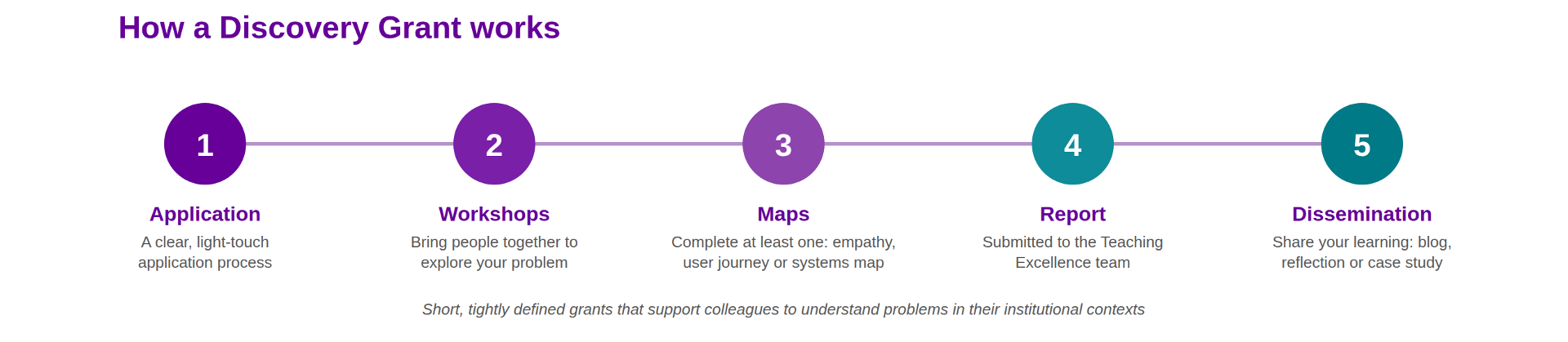
Staff can apply for a Discovery Grant of up to £300 which can be used to pay for catering and/or vouchers for students or those not employed by the University in recognition of their participation and time. All spending must occur by Wednesday 30 June 2027.
Awardees are required to complete at least one of the following to capture the learning and insight gained:
The completed map will form part of the Teaching and Learning Discovery Grant report which should be submitted to the Teaching Excellence team. Awardees will be expected to share the findings of their work within their local context;, this might be sharing with the relevant programme directors or Head of Department/team or at a local Teaching and Learning or Department meeting. The Teaching Excellence team can help you to identify the most appropriate forum if this would be helpful, and can help facilitate dissemination of the report to the appropriate committee(s) and/or group(s).
Colleagues will also be encouraged to share their experiences and findings through short blogs, reflections or case studies, helping to build and share evidence across the University, contributing to institutional learning through locally-led innovation, teaching enhancement and scholarship activity.
How to apply
Applications for Teaching and Learning Discovery Grants will be assessed against the following criteria:
- Is the problem being investigated related to education or student experience?
- Is the project explicitly situated within the Manchester 2035 strategy?
- Is the problem well explained?
- Is the problem pressing?
- Is the problem widespread?
Deadlines will be updated below and shared via the TALON Viva Engage group and the Teaching-Focused mailing list.
Upcoming deadlines:
- Friday 30 October
Resources and templates
Empathy map
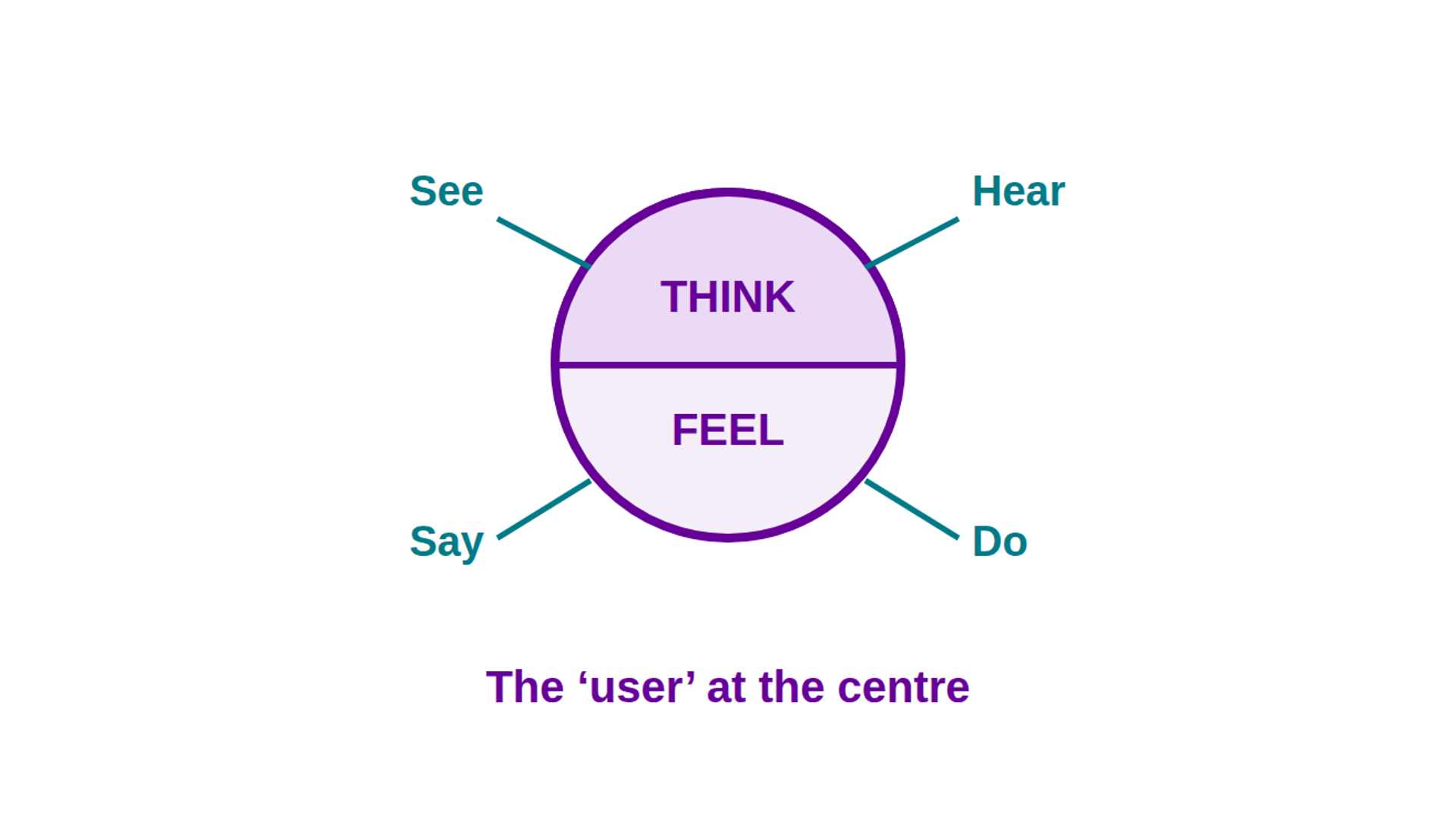
Empathy Maps are used to build a rounded understanding of how ‘users’ experience something. In a teaching and learning context, our ‘users’ are likely to be students but may also be colleagues, school pupils, teachers, or others connected with the University.
As a workshop activity, creating an Empathy Map means bringing together groups of people - academics, students, professional services staff, for example - to explore and set out experiences and needs of a fictional ‘user’. The completed map can be used – along with empathy maps for other users and journey maps – to understand the rounded experiences of people who are impacted by the problem you are exploring.
User journey map
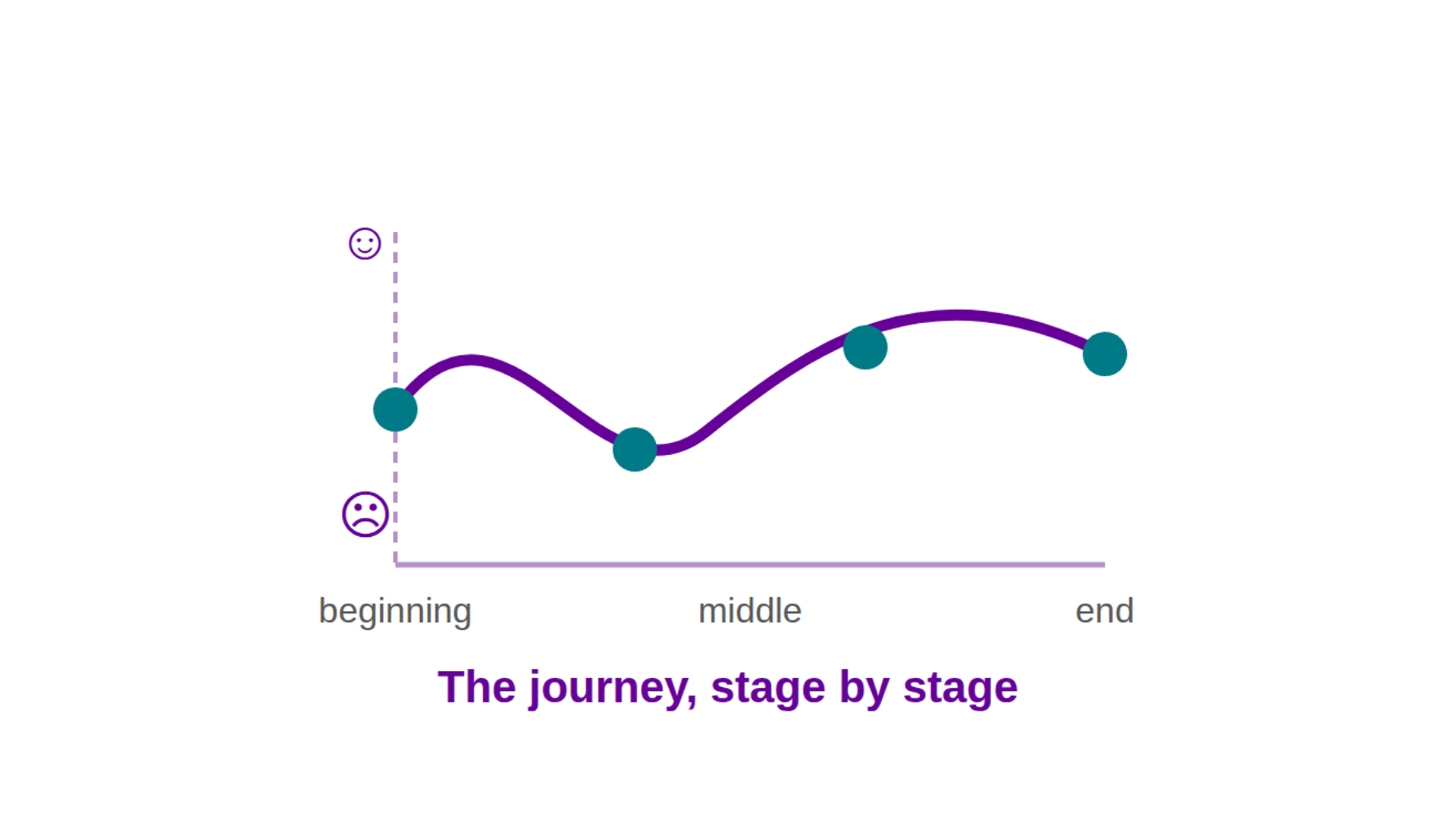
A User Journey Map can be used to understand a user’s experiences of undertaking a task or process related to what you are investigating. During a workshop, you’ll ask your participants to explain what is involved in each step of the process and how it is experienced. To create a User Journey Map your workshop should bring together people who are similar to your imagined user, with relevant experience to draw on. As with an Empathy Map, your ‘user’ could be a student, educator, professional services colleague, or someone else connected with the university.
Systems map
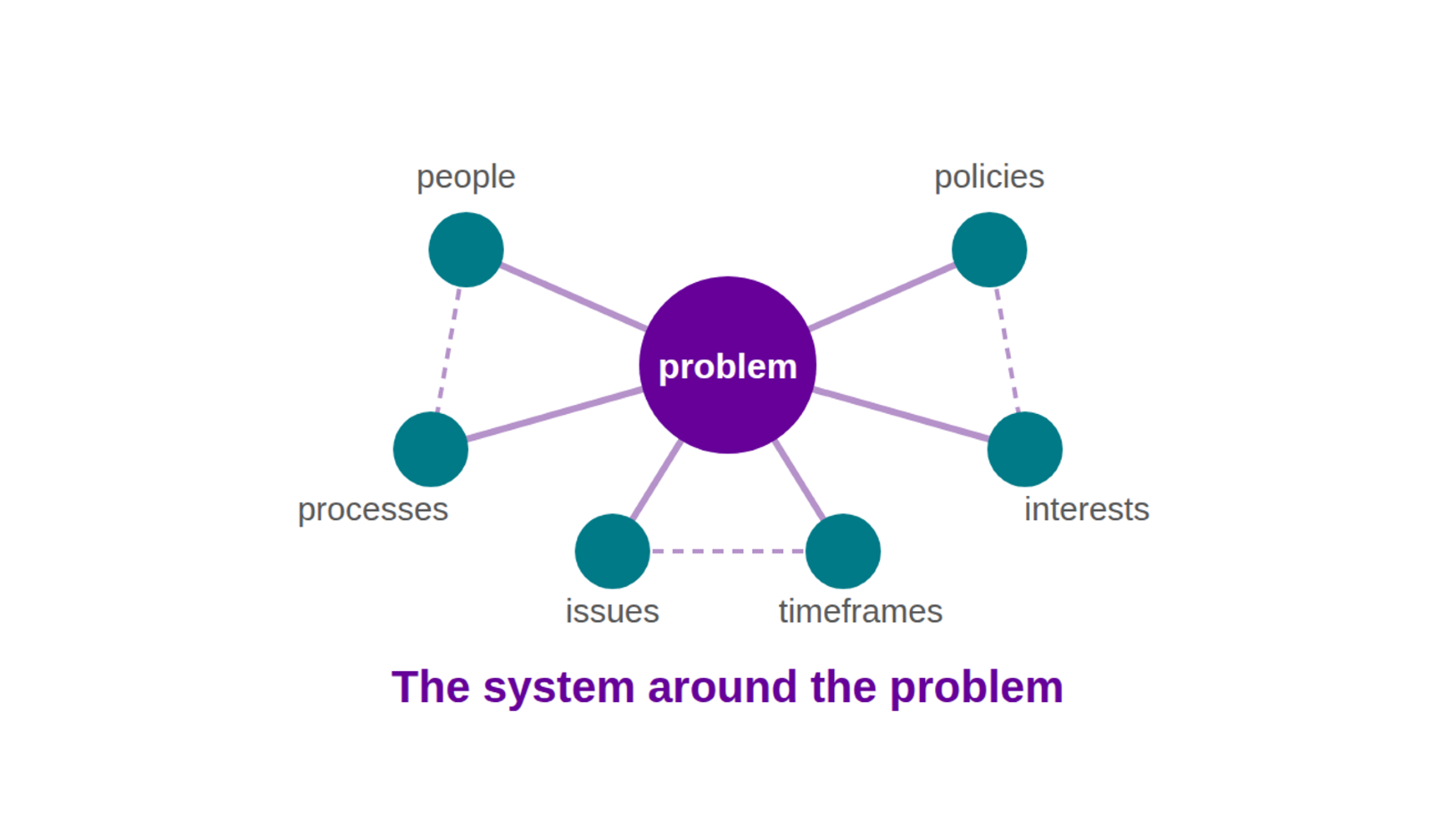
A Systems map is a tool that helps you visualise a problem and the context it occurs in. Different elements — people, processes, policies, interests, issues, timeframes — and their interactions can create complex systems around your problem. A Systems map helps you to see the ‘big picture’. It should help you identify who is affected by your problem, and what their interests and needs are for any possible solution. Seeing relationships, tensions, crossovers and absences can provide new insight into priorities and areas of potential impact as you think about how to address the problem. To create a robust systems map, it’s important you gather input from a diverse group of people across different job roles to gain a fuller representation of the wider system. This can be done in a workshop with the possibility of additions from other groups who couldn’t attend.
Case studies
These case studies are real examples of how design-thinking can be applied to HE teaching and learning for discovery and enhancement and the impact on both staff and students.
The Student Change Lab
About the Student Change Lab
The Student Change Lab was an initiative focused on improving student partnership and feedback processes by using human-centred design approaches. The project aimed to equip student representatives and staff with human-centred design tools and approaches to strengthen empathy, collaboration and partnership and support meaningful change, ensuring that the time and effort invested by students and staff in feedback processes leads to tangible outcomes.
Student blogs
- The Student Change Lab: Learning and co-design to unlock the creativity of our academic student reps (TEA blog)
- The Student Change Lab: How to best analyse feedback - reflecting on my experience at the Student Change Lab (TEA blog)
- The Student Change Lab: Reflecting on using journey maps to capture the Student Experience (TEA blog)
Suggested reading
Design-thinking or Human-centred design in Higher Education
- Dyer, S. and Deacon, K. (2023), "Discovery Grants for Education Innovation: Supporting the Adoption of People-centred Design in HE One Step at a Time", International Journal of Management and Applied Research, Vol. 10, No. 2, pp. 231-244. https://doi.org/10.18646/2056.102.23-018 (opens in new window)
- Dyer, S and Kuzmina, K. (2024). "Prototyping educational change: Learning from a ten-week service design programme", in Newton, R., Mutton, J., and Doherty, M. (eds.) Transforming Higher Education with human-centred design. London: Routledge, pp. 102-116. https://doi-org.manchester.idm.oclc.org/10.4324/9781003383161 (opens in new window)
- Newton, R., Dyer, S., Lopez, I., Morgan, T., Trowsdale, D., and Iftikhar, F., (2025). Design Thinking for Higher Education. Available at https://www.advance-he.ac.uk/knowledge-hub/design-thinking-higher-education-dt4he (opens in new window)
- Newton, R., Mutton, J., and Doherty, M. (eds.). (2024). Transforming Higher Education With Human-Centred Design (1st ed.). London: Routledge. https://doi.org/10.4324/9781003383161 (opens in new window)
Contact
If you have any queries about the UoM Teaching and Learning Discovery Grants, please contact Beth in the Teaching Excellence team.