


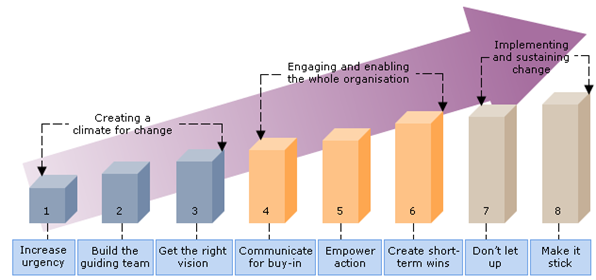
Why use Kotter's 8 Step Change Process in leading change
Professor Emeritus John Kotter of the Harvard Business School is a renowned expert in leadership and change. His 8 Step Change Process is internationally recognised and very popular with many organisations across the world.
A handy guide to Kotter's 8 Step Change Process
Step 1: Increase urgency
Why:
People need to acknowledge change is needed.
In practice:
Build a case for change describing why the change is needed.
Step 2: Build the guiding team
Why:
What needs to be changed must be defined.
In practice:
Gather together the right people (no matter who they are or their grade) to help create the new vision.
Step 3: Get the right vision
Why:
A clear vision helps to focus direction.
In practice:
Create a new vision which responds to the case for change and which stands up to challenge.
Step 4: Communicate for buy-in
Why:
Momentum for change must be created.
In practice:
Engage with key audiences to excite and motivate them about the change and to get them involved – enlist an army of champions.
Step 5: Empower action
Why:
The right skills, tools, and systems must be in place to empower people to change.
In practice:
Understand what roadblocks need to be addressed to remove cynicism and tackle any feeling of disempowerment.
Step 6: Create short-term wins
Why:
Retain and further drive momentum by showing people early benefits.
In practice:
Provide evidence of what could be possible by implementing and celebrating some early wins which can be made easily and quickly.
Step 7: Don't let up
Why:
Change can be challenging and perseverance is key.
In practice:
Address any challenges, learn from mistakes, celebrate successes, and continue to implement change, while rewarding people who are driving and championing change.
Step 8: Make it stick
Why:
Change needs to be embedded to be fully realised in the long term.
In practice:
Use the tangible results of change to create an institutional culture which welcomes and rewards change.
Further reading
There are a number of useful case studies which explain why and how Kotter was used to help achieve success from Ericsson, to a global manufacturing company undergoing change.